Antigone: The Musical

Antigone: The Musical

I first came across the Antigone story in a drama class in Year 9 and it stuck with me all the way to university, when I had an opportunity to study it again in my Classics degree.

When I decided I wanted to write a musical, I had a few different ideas, but none of them excited me as much as the idea of Antigone: The Musical. Antigone is such a strong, compelling character and her relationship with her sister really spoke to me. Parts of the play translated perfectly to musical theatre- the argument between Antigone and Ismene became a duet, as did the final confrontation between Antigone and Creon, whilst Haemon’s unrequited pining for Antigone seemed an obvious subject for a ballad.

That said, adapting it wasn’t the easiest. I quickly realised that I couldn’t end my first musical in a triple suicide. This was the point when I found out that Euripides had in fact written a version of Antigone in which Haemon saves the day. This version, combined with my own political leanings and experiences of protests, created a very new ending to the story featuring a people’s revolution- but you’ll have to watch the show to find out more!

Lots of people have said I’m ‘bold’ for adapting Antigone this way, but I’m not sure that’s entirely true. Classical literature has been subject to retellings and changes since its very beginning (I’m thinking of Sappho’s Homeric poems, or Vergil’s Aeneid). Antigone: The Musical is simply a successor to a long tradition of adaptation and transformation.

I’ve been so happy with the reactions to it in Edinburgh. I bumped into a group of 17 year-old girls and their teacher who had studied it recently and were very excited when I said I thought Antigone was a girlboss. The group left with a bunch of flyers, still chattering about their memories of studying the play and their opinions on the characters. I honestly don’t mind whether they actually see the show or not- I’m just glad to have prompted a conversation.

Antigone is clearly a story that resonates with many people- a young girl standing up to a tyrannical older man feels like it could have been written the 21st century AD just as much as the 5th century BC.

I’m sure I’ll get a few raised eyebrows for the changes I’ve made and it’s not going to be everyone’s cup of tea. But it’s fun, it’s a bit silly and it’s got heart. My hope with bringing this adaptation to Fringe is to reach audiences who might otherwise not want to watch a Greek tragedy, and to show that Classical stories can absolutely be enjoyable and relevant to our lives.

photo credits: Marina McCready

poster credit: Anna Piper-Thompson

Posted in Event Roundups

The Interwoven Roots of Plants and Greek Myths

The Interwoven Roots of Plants and Greek Myths

Like many other people, the not-too-distant lockdowns created a space and stillness in my life which nature began to fill. From starting to recognise more of the little birds that visited our garden, to taking joy out of the vibrant orange and purple colours of the wildflowers growing in the verges of the nearby road, I grew to love things I had often not noticed before. 

It was from these long days, long walks, and quiet times, that the idea for a series of books called Telling Tales in Nature grew. Some of the myths I have always found most alluring have been those about the underworld, and so I decided to set the first little book in the series, Underworld Tales, there.

Stories, and in particular, myths, are a lot like plants, I think. They spring up often unexpectedly, they self-germinate, but with interesting variations, and before you know it, they are a flourishing ecology. And like nature, they are nourishing in a very deep way, providing wider and different perspectives, and new ways of looking at things. Stepping inside a myth is a lot like stepping inside a wood. It’s different each time, and you never know what you will find!

Increasingly, I bring nature into my teaching and lessons wherever I can for this reason. I find children and adults alike have a joy in knowing the different versions of stories, of hearing them over again, and seeing them in new ways. I find they take a similar pleasure in learning about plants of all kinds, so using stories which are interwoven with nature feels fitting. More than ever before, climate change calls for us to take a different approach to our lives and the nature around us, and I think that ancient ways of viewing plants and nature can help remind us of that interdependence and reliance that modern life can make us forget.

In the book, I start by introducing the plant itself, and giving some simple details about where it grows, what it looks like, and how people have used it in daily life. I then introduce the myth which is associated with the plant, before retelling the story from the perspective of the plant itself. In accordance with ancient Greek and Roman ideas about the spirits which inhabit different aspects of the natural world, I have imagined these spirits as nymphs. I finish with a new brief notes on ancient sources for the stories for those who want to explore further.

A talented young artist, Lydia Hall, who is based in Oxford, has created botanical illustrations for each of the plants, and also drawings of the characters and places imagined in the stories. Three of the myths are re-imaginings of ancient stories but in the case of Asphodel, I invented a completely new story for the plant, since one didn’t appear to exist. Lydia has created a mysterious, wistful, gently gloomy backdrop for all the stories, and she has drawn the characters with a careful eye for their view of the stories.

The plan is to create a series of these little books which explore lots of different plants and stories in different realms, from forests to gardens, and from seas to rivers. They are aimed loosely at ages 8+ to adult. I hope that they are simple enough for quite little ones to enjoy, and detailed enough for older children and adults, but I welcome all feedback on this first book, and am looking forward to seeing where it goes.

Contact Lorna by email at lro@cheneyschool.org

“Telling Tales in Nature: Underworld Tales” can be purchased as an e-book and paperback here.

All images: © Lydia Hall

Posted in Community Classics

Introducing Vocabulous

Introducing Vocabulous

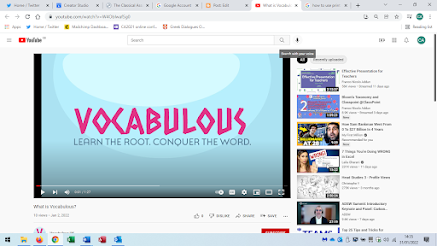
Vocabulous is an exciting new resource that aims to improve students’ English vocabulary by teaching Latin and Greek root word patterns in KS2/KS3 English lessons.

When Year 7 students were asked what they like about the website, responses included:

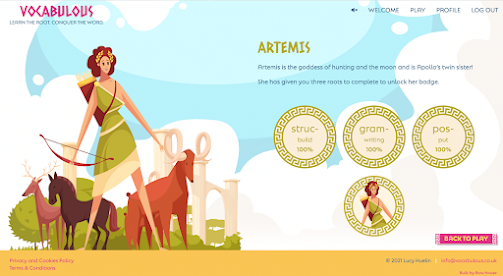
  • “I like that you earn the Greek God badges when you complete levels.”
  • “I like how clear the videos are.”
  • “I think it is a fun way to learn the root words.”
  • “I like how you can see how your class is doing.”
  • “I like the pictures, especially Hades!”
  •  “Everything. It’s in a simple and easy to understand format.”

Vocabulous has received funding from The SHINE Trust and is currently in the first year of a two-year trial programme. We are looking for schools to participate in the second year of the trial, with either Year 6 or Year 7 students. We would especially like to hear from schools with an above-average proportion of students receiving Pupil Premium. Please email info@vocabulous.co.uk if your school would like to take part.

To find out more about Vocabulous, follow @VocabulousUK on Twitter or go to www.vocabulous.co.uk.


[1] Green, T. M. (2008). The Greek and Latin roots of English (4th ed.). Lanham, MD: Rowman & Littlefield.

Posted in Classics in Action

The CA Returns to Swansea

The CA Returns to Swansea

In April 2022 the prestigious annual Classical Association conference took place at Swansea University. The conference was due to take place there in 2020, which would have been rather fitting as the University marked its centenary that year, but we all know what happened that year and in subsequent years.

Despite the challenges of the global pandemic, which had a significant impact on our jobs and our well-being, the conference returned in full swing in 2022. I, like many others, was looking forward to catching up with old friends and making new ones, in real life! The advantage of the conference was that it offered a hybrid option; so those who were unable to travel for various reasons, including the dangers of the lingering virus, could also participate remotely. After all, if anything the pandemic has taught us it is the flexibility of technology to access lectures, attend virtual events and workshops, and to participate in panels with colleagues from across the globe on a number of topics without leaving the comfort of your home.

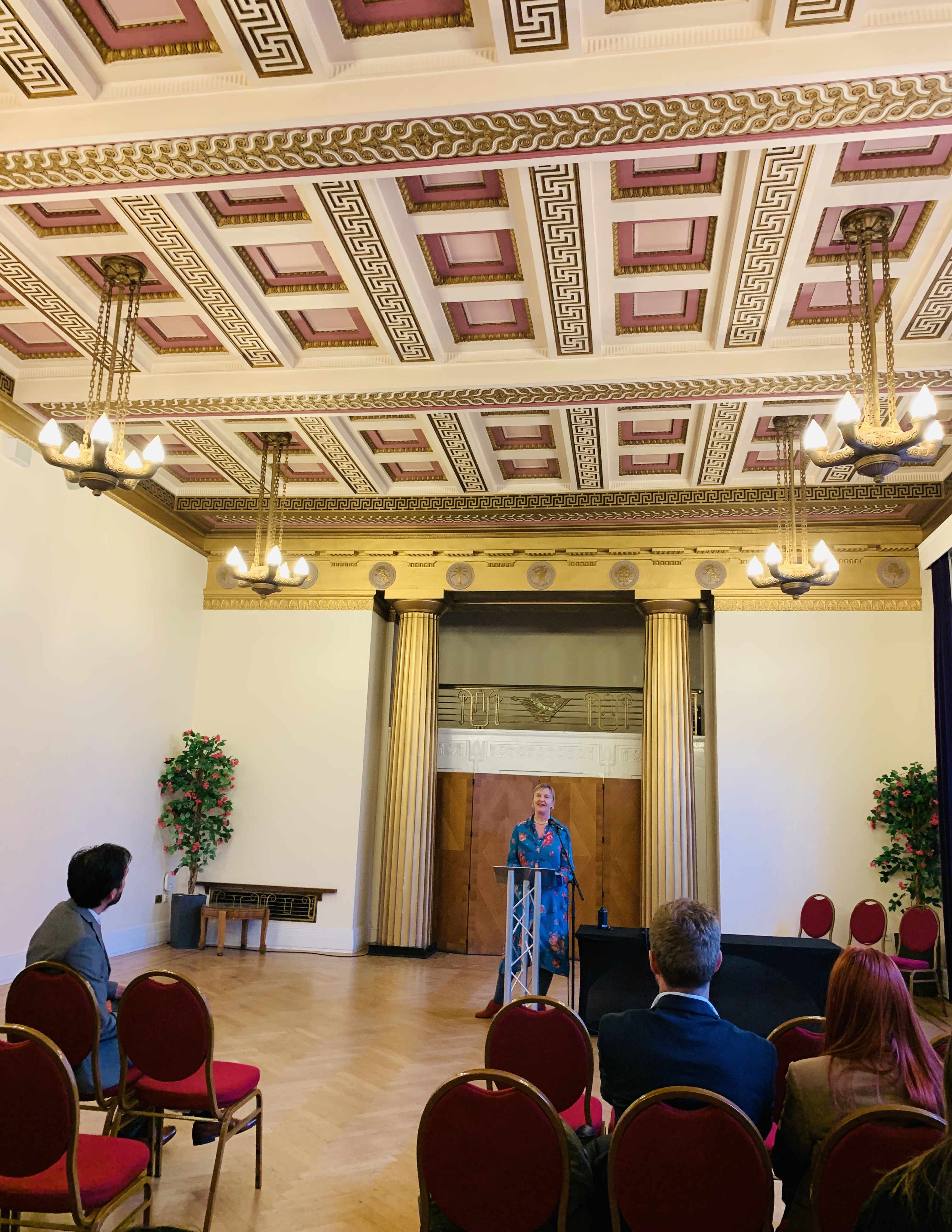
A reading by Charlotte Higgins at the Guildhall complex

 For me, the location of this year’s conference had a special significance. Swansea was my adopted home; I spent a large portion of my life studying and working there. I undertook all my degrees at the University, seeing the institution go through many changes, including the Classics department which used to be called Classics, Egyptology, and Ancient History and now has a new name – History, Heritage, and Classics. This shows the changing landscape of our disciplines in the 21st Century and perhaps shows the flexibility of our subject in that it can fit in and be comfortable with the humanities brand. Two days before the conference I found out that I was successful in an interview for a job based around public engagement and heritage – guess where? Swansea! It was a very sweet moment to realise that I would be returning to the department where it all began back in 1999, it felt rather Odyssean and had a lovely circular feel to my journey after spending 10 years in Oxford.

I was delighted too that the organisers of the conference wanted to continue the inclusive nature of these annual conferences, which for me was the highlight of the last CA conference that took place before the pandemic. At the 2019 FIEC/CA conference in London, I was fortunate enough to be part of not one but two panels which were ground-breaking in terms of their set-up: the plenary panel on the first day was an all-women affair, which looked at inclusivity and Classics. The second panel on the third day involved all-women from BAME background. Not to mention the various workshops on public engagement and outreach as well as pedagogy. In Swansea this year it was encouraging to see that the organisers wanted to continue the tradition of making the conference as inclusive as possible – both in the diversity of the papers and panels as well as accessibility.

I was lucky enough to chair a panel on Meroe and Nubia, which brought together Classicists and Medievalists looking at historical, archaeological, and literary approaches to the Northeast region of Africa. The academics presented their papers in a hybrid fashion (some were based in the US and Poland) so there was a sense that nobody was missing out because of travel/financial constraints. At this point I want to thank both Dr Ian Goh and Maria Oikonomou, the Swansea CA conference organisers, for making the time difference so bearable for our speakers! The other panel I was involved in was the Persia panel. It was such pleasure to be giving a paper alongside my former external examiner Prof. Lloyd Llewellyn-Jones, but the highlight has to be the added feature of our panel which included ‘Persia on the Curriculum’ led by three fantastic school teachers – Peter Wright (Head of Classics, Blackpool Sixth Form College), James Renshaw (Classics Teacher, Godolphin and Latymer School), and Anna McOmish (Head of History, Aldridge School). The fruitful discussion that followed amongst participants and attendees is possibly the reason why the annual Classical Association is so successful – that marrying up of university and school teaching and learning, a truly collaborative affair.

Other highlights of the conference included the inimitable Charlotte Higgins as she read an extract from her latest book ‘Greek Myths: A New Retelling’ in a rather fitting setting of the neo-classical and art-deco designed building the Guildhall complex (part of the offices of the City and County of Swansea Council). Of course, the biggest highlight of the annual conference is the conference dinner, and for obvious reasons this year had a special meaning to it. The setting – that neoclassical/art deco flair of the building, the classical music – led by Dr Ian Goh (who knew he was a professional violinist!), and of course the announcement of the CA Prizes. As the 2019 recipient of the CA Prize, I knew how special these prizes were and what it meant to the recipient. I was especially delighted to witness that this year’s winner was Dr Cora Beth Fraser who has taken Classics outreach to another level. You can find out more about Cora and her work here – you will have to agree that the CA couldn’t have found a more worthy winner!  

I wanted to conclude with a quote from another CA prize winner – this time from the Teaching category. L E Jenks-Brown’s experience of the CA conference this year, where she presented her first conference paper, really does capture the buzz and inclusive nature of the event: 

“It was a relief to be able to find quieter areas, such as the seating near the bookshops, and the Neurodiversity panel’s safe space near the main lecture theatre, to which to retreat.

The hybrid nature of the conference was also really interesting, as it enabled a lot more speakers as well as listeners to be in attendance. I found the lectures on physical objects and reception the most personally interesting. I loved the chance to handle objects from the museum, and the teaching-focussed pedagogical panels were extremely interesting and useful.

As I was staying with my husband and toddler outside of Swansea, I missed out on some of the social aspects of the conference, but the conference dinner with the presentations on the Sunday night was really exciting, and the whole conference was nice chance to catch-up with IRL (in real life) and Twitter friends.”

Dr Mai Musié is an Ancient Historian and Public Engagement Specialist, and is Public Engagement Officer for History, Heritage, and Classics at Swansea University.

Email: m.musie@swansea.ac.uk ; maimusie@outlook.com

Website: drmaimusie.com

Twitter: @Dr_MaiMusie

Posted in Event Roundups