A Manifesto for Today

Paige Dewbrey

Winner of our 2025 Write | Speak | Design Competition, Paige is a student from the US, who delivered the following manifesto in response to the question ‘Why is Classics important?’

Against Justification: The Unruly Necessity of Classics

The question “Why is Classics Important?” is, at first blush, an offense—a query lobbed like a molotov cocktail into the salons of those who have long been drunk on the wine of antiquity. It presumes justification, invites an embarrassed clearing of the throat, and hints at the need to defend, as though Classics were a guilty pleasure, a relic of some ancestral folly. It’s not just a question; it’s a dare, laced with the suspicion that we’re wasting our time, clinging to the intellectual equivalent of vinyl records in a Spotify world. To answer it with sincerity risks pandering; to answer it with irony risks alienation. Yet, here we are, poised on the precipice of such a provocation, daring to articulate why the foundations of Western thought should remain more than an archaeological curiosity. Why, indeed, should we care? How can we care, in times like these?

Let us dispense with the predictable litany of boilerplate defenses: that Classics teaches us critical thinking, that it’s the cornerstone of Western literature, that it grants us access to “The Great Conversation”, whatever that means. While these things are probably true, they’re also deeply boring and sound suspiciously like we’re trying to sell you a subscription to something you’re not even sure you want. It reeks of a kind of desperation, a flailing attempt to make the discipline palatable to a world hungry for “relevance”— reducing the Classics to a commodity, as though what truly matters about Homer or Cicero is how neatly they fit into a PowerPoint presentation on transferable skills. These arguments are scrubbed of texture, passion, and color—much like those alabaster statues once painted in gaudy hues but now left a pallid white by centuries of well-meaning neglect. Classics is important not because it flatters the mind or adorns the CV but because it unsettles, disrupts, and even humiliates. It makes you feel small.

Uncomfortably, thrillingly, existentially small. It is not an ornamental pedestal but a mirror, and the reflection it casts is often grotesque, sublime, and deeply human. The texts are riddled with contradictions, omissions, and unspeakable violences, and therein lies their power. The importance of Classics lies not in its completeness but in its absences, in the spaces where we are forced to imagine, to reconstruct, to mourn. They aren’t sacred relics; they’re raw materials, unfinished and unfinishable. To dismiss Classics as irrelevant—as some do, branding it the purview of crusty academics and reactionaries—is to misunderstand its radical potential. Classics is not a shrine to be venerated but an autopsy to be performed, an excavation of power in all its naked, bloody forms. The Greeks and Romans were not moral exemplars; they were imperialists, colonizers, and enslavers. To study their works without acknowledging this is to engage in a kind of intellectual tourism. But to confront these realities head-on is to wrestle with the mechanisms of domination that persist today. The rhetoric of Cicero, the politics of Augustus, the spectacle of the Colosseum—all are templates for modern machinations. To know them is to know ourselves, our complicities, our vulnerabilities.

Yet, Classics is not merely a catalog of atrocities. For amidst the violence and ambition and moral hypocrisy lies something ineffable: wonder. The geometry of Euclid, the metaphysics of Plotinus, the comedies of Aristophanes—these are gifts that defy utility, existing for the sheer joy of thought and expression. To engage with them is to affirm that human beings are not merely tools of production but creatures capable of transcendent beauty and discovery. Classics affirm that we are not merely tools of labor or cogs in an economic machine but creatures capable of astonishing leaps of thought and creativity. It is a reminder that some things—perhaps the best things—exist not because they are useful but because they are true. This, too, is why Classics matters: it insists on the value of the impractical, the ineffable, the sublime.

But let us not sentimentalize. Classics can be maddeningly obtuse, exasperatingly elitist, and, at times, staggeringly dull. There is no denying that parts of the canon are tedious, that the fetishization of Latin declensions has driven many a student to despair. Yet even these aspects serve a purpose. To grapple with the impenetrable is to cultivate humility, patience, and a tolerance for ambiguity. It is a reminder that not all knowledge comes easily and that some truths must be earned through struggle. In a culture of hot takes, of TikToks explaining Marcus Aurelius’ Meditations in 30 seconds, and of audiobooks consumed at 1.5x speed, the Classics represent an outrageous affront. They demand that you slow down, learn new grammatical cases, and parse the subjunctive moods of dead languages. But why should we care about subjunctive moods or dative absolutes when we can have answers—not mere reflections—delivered in milliseconds?

The answer lies not in what the Classics give us but in what they take away. They strip us of our modern illusions: the illusion of mastery, the illusion of immediacy, the illusion that knowledge is merely information in fancy dress. The Classics remind us that understanding is an act of patience, that wisdom is not speed but sedimentation—a slow layering of insights, accreted through effort, frustration, and even boredom.

Imagine a world without unnecessary skills. It would be, at first glance, utopian: a sleek, hyper-efficient mechanism in which every action serves a purpose, every moment yields tangible results. But examine it closer, and it reveals itself as horrifyingly hollow. What becomes of play? Of curiosity? Of the peculiar joy of doing something not because it is useful, but because it is hard, and in its difficulty lies a kind of transcendence? It is precisely this difficulty that the Classics offer—not as a burden, but as a gift. They demand that we slow down, not because slowness is inherently virtuous, but because it is in slowness that we begin to think. They frustrate us, not out of malice, but because frustration is the crucible in which clarity is forged. They are inefficient, and in their inefficiency, they mirror life itself: messy, unpredictable, and resistant to easy solutions.

And so, to read the Classics is to practice a kind of spiritual disobedience. It is to say: I will not be reduced to a consumer of content; I will not confine myself to what is easy or digestible. It is to assert that some things are worth doing precisely because they cannot be justified in terms of utility or optimization. The subjunctive moods of dead languages, the labyrinthine syntax of Cicero, the aching beauty of Homer’s hexameters—these are not relics; they are revolutions. They teach us not only how to read but how to live: slowly, thoughtfully, and with an unyielding reverence for the unnecessary. And in that toil, there’s a kind of beauty—a sacred discomfort that forces you to confront the limits of your patience, your intellect, your willingness to care.

I remember this one afternoon in my school’s Latin Club when I somehow managed to keep the room’s attention, including a few stray interlopers who’d wandered in looking for free donuts. The text we were wrestling with was Catullus 101, a poem so old and sad and stripped of pretense that it felt almost indecent, like you were eavesdropping on someone mid-sob. The task, predictably, was to break it apart: meter, scansion, translation. What wasn’t predictable was the way the room fell quiet, people leaning forward like something in the bones of the thing demanded it. We argued over the rhythm, tripped over Latin words that weren’t built for our mouths, and tried to explain how a 2,000-year-old funeral poem could still punch you in the chest. It wasn’t about cracking the code—though that was its own kind of rush—but about theway the room shifted into this weird collective focus, all of us orbiting the same point for once. It wasn’t sacred, not exactly. But it stuck, the way good discomfort does.

Of course, there are problems with Classics: that Classics is too Eurocentric, too bound up with the narratives of white supremacy, for instance. This critique is not without merit; the discipline has often been wielded as a tool of exclusion and domination. But to abandon Classics on these grounds is to cede the field to those who would weaponize it. Instead, we must reclaim it, interrogating its biases, expanding its boundaries, and situating it within a global context. The Classics are not the exclusive property of any one culture; they are part of a larger, messier human inheritance.

And what of the common charge that Classics is irrelevant in an age of climate crisis, social upheaval, and technological acceleration? This, too, is a misunderstanding. The ancient texts are, in many ways, premonitory. The ecological devastation lamented in Ovid’s Metamorphoses, the political corruption satirized by Juvenal, the existential despair of Lucretius—these are not relics of a bygone era but resonances of our own. Classics teaches us that the past is never truly past, that its ghosts linger in our language, our institutions, our imaginations. Perhaps the most compelling argument for the importance of Classics is that it resists easy answers. It is a discipline that thrives on tension, on the interplay of opposites. It is at once conservative and radical, timeless and timely, universal and particular. To study Classics is to inhabit these contradictions, to revel in their dissonances, and to emerge, if not wiser, then more attuned to the complexities of existence. And so, we return to the question: Why is Classics important? Because it is difficult, maddening, and essential. Because it confronts us with the best and worst of ourselves. Because it demands that we think, feel, and imagine beyond the narrow confines of our present moment. Because it refuses to be reduced to soundbites or bullet points. In a world increasingly obsessed with the new, the immediate, and the disposable, Classics is a reminder of the enduring, the profound, and the sublime. And that, surely, is reason enough.

©PaigeDewbrey

For further inspiration, enjoy this spoken word piece by Catherine Perkins, winner of the 25+ Competition

Posted in CA News, Classics in Action

My Life and Classics

My Life and Classics: Two Perspectives

Two of our CA Members with very different jobs – an actor and a business analyst – are united by their love for ancient storytelling and how Classics infuses their working lives…

Douglas

I am delighted to have been asked to be an advocate for The Classical Association’s #CelebratingClassics Campaign.

My love of Classics began, I think, with a birthday present when I was about eight years old: a copy of The Myths of Greece and Rome by H.A. Guerber. I was captivated by the adventures of all those immortal gods and goddesses, who seemed to reflect all the good and the bad in us mortals! I was born in the 50’s so I remember all those classically inspired films: Jason and the Argonauts, 300 Spartans, Hercules, Clash of the Titans, and many more. I began to learn Latin when I was nine, and Greek a bit later, and it was the languages that really sold me on Classics; what a wonderful window into the lives and culture of those ancient societies, at once so different and then again so like ourselves.

A study of Classics in all or in any of its disciplines will give you such a sought-after set of skills for the job market, too. Classicists have been well known to be able to turn their minds to almost anything  – need a problem solved? Get a Classicist!

The Roman advocate, Cicero, left us with a brilliant and succinct argument for the need to study the past. I will let his advocacy speak for me: ‘Not to know what happened before you were born renders you always a child.’ ( nescire autem quid, ante quam natus sis, acciderit, id est esse semper puerum. Brut, 34, 120)

So, here I am now, an actor. ‘How relevant is Classics to that?’, I hear you ask. Well, beyond the obvious, that without Greek and Roman Tragedy and Comedy, we would never have had Shakespeare, the study of it has deepened my appreciation of performance – yes, even in Downton Abbey! And if you opt for a Classical subject, you’ll get to read, either in the original or in translation, some of the greatest literature ever written.

Douglas Reith is an actor, perhaps best known as Lord Merton from the TV series and films of Downton Abbey

Bex

The question “Why is Classics important?” feels almost as old to me as Classics itself.  

When I was about nine years old, my dad read bedtime stories to me from a book about Greek mythology. I still have the book today. The fly cover depicts Medusa and Perseus, it’s tattered and torn, and the binding is falling apart, but still it evokes such deep feelings of joy in me. The stories seemed so exciting and heroic to my young mind, and I firmly believe that they set the foundation for my lifelong love of Classics.  

I toyed with the idea of studying archaeology when I was 18, but eventually I went out into the world of work. Time passed and I did several different kinds of jobs. I worked as a manufacturing systems engineer, then in a range of technical and operational roles in publishing, culminating in running a customer service and despatch team. Then when I was around 30, I found myself revisiting the idea of studying for a degree. 

I knew I was going to have to study in the evenings, and that I was going to have to continue to work full time. I also knew that I needed to choose something I would really love. After all, if I was going to do this after hours, I needed to give myself the best chance of success. It took me about three minutes to settle on Classics. I finished the degree, and then I put Classics down again, whilst I had a family.  

Roll forward ten years and in the back end of last year, I had a very significant change to my personal circumstances. I was left wondering what on earth I would do with my life, and during a conversation with a close friend of mine, he, knowing about my love of Classics, suggested this might be a good time for me to reconnect with the subject.  

I found the Classical Association and took the plunge of becoming a member and booking to come to the annual conference. I was pretty anxious about it at the time. I didn’t know anyone. I wasn’t an academic. I thought there was a real chance I could show up and not understand anything I listened to, but I thought the worst that could happen was that I wouldn’t go again. So off to Warwick I went.  

I had an incredible time. Everyone there was friendly and welcoming and whilst I was there, I volunteered to help the CA’s mission. I’ve loved every minute of working with them since, and I was very moved when asked to write this piece. So, after all the above, why is Classics important?

To me, it’s important because it gives us a lens into the human condition thousands of years ago. That lens helps us understand much about the cycles we still find happening in the world today. Be they emotional, political, societal. For me, Classics is foundational. It’s a subject which comes from a time before human beings had categorised subjects into specialisms for study. I like to view thinkers in the ancient world as the original Systems Thinkers. Systems thinking is a way of thinking about something as part of a larger whole, and it’s pretty useful if you’re a business analyst, like me, developing processes or computer systems. Ancient philosophers thought about nature, and physics and ethics and aesthetics and emotions to name but a few. This way of thinking lets us observe connections between things that we might not otherwise be aware of. It’s vital to producing effective solutions to the world’s problems and I can see it all over the ancient world. 

Classics is important to me because it reminds me that technology changes, but people remain the same. I remember studying my undergrad in the run up to 2012 when the Olympic stadium was being built in London, and reading the views of people opposed to this use of taxpayer money and then finding similar views about Herodes Atticus’ Olympic stadium in 140 CE. Classics teaches us that the way that human beings respond to challenges in life, the anxieties they have, the things they worry about, remain universal and that is a source of great comfort to me.  

More recently, I have been interested in what Classics can teach us about authoritarian leaders. Given the rise of such leaders around the world in recent times, I am interested in the parallels of those kinds of personalities through time, what they sought to achieve and how they operated. It feels to me that the kind of insight Classics can provide into this continues to make it hugely important and relevant as a subject of study today.  

I’ll end by saying that Classics has helped me develop an understanding of storytelling and of critical thinking that I deploy in my job every single day. But more than that, Classics is a subject which inspires me. I use much of what I’ve learned about oracy in creating and telling stories in all sorts of formats, and often, we can see the tropes and themes of classical literature in many of our modern stories. These tropes and themes give us a common language of understanding with which we can communicate with and to each other, build communities, and bring people closer together, all of which is necessary for us to solve the problems we face in the world today. 

Bex Sleap-Ireland is a systems manager who has worked in data and analysis across the charity and university sectors; she is also a storyteller.

Posted in Community Classics

Slaves and Sanctuary: Expert blog

Dr. Jessica Clarke

Our Expert in Residence, Dr Jessica Clarke, shares some of her latest research in this member blog. These objects are discussed in further detail in her forthcoming book 
A New History of Ancient Roman Theatre, available for pre-order from Liverpool University Press.


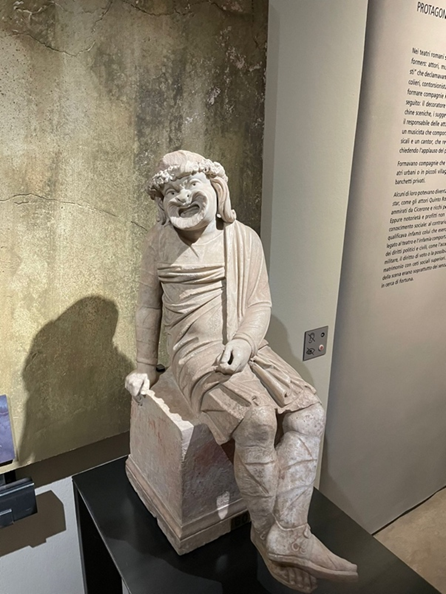
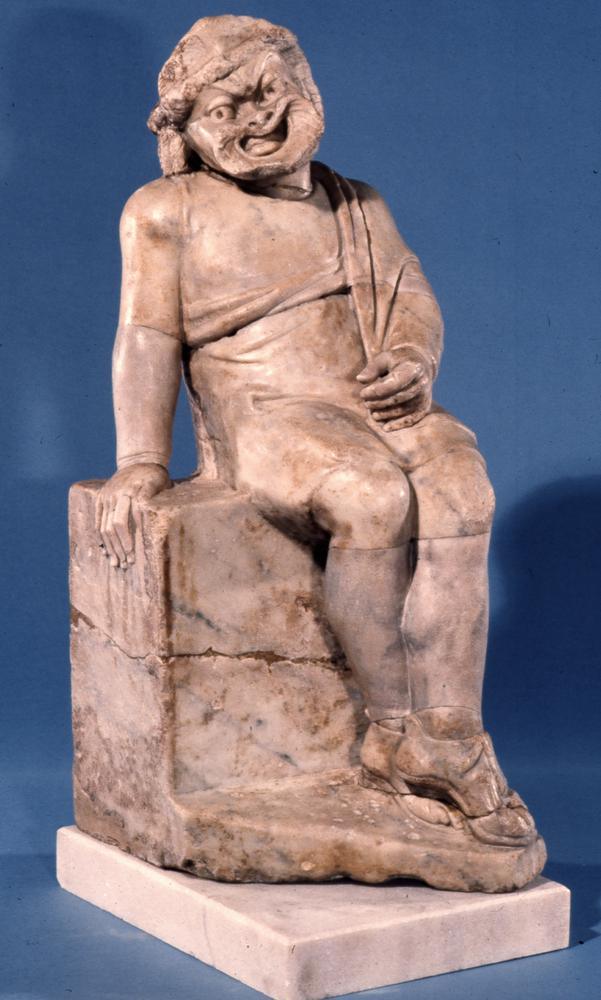
High on a shelf in the Vatican’s Museo Pio Clementino, largely overlooked by the crowds flowing through the Galleria dei Candelabri, sits a finely carved marble figure of a comic slave character. Perched just above eye level, this remarkable object (inv. 2661) receives little attention from passing visitors, and even less in current scholarship. Yet it offers a powerful and revealing glimpse into the entangled world of theatre, political hierarchies, and enslaved experiences in the ancient world.

The statue, carved from high-quality Carrara marble sourced from quarries in the Luna mountains, stands at approximately 115cm tall. It depicts a familiar figure from Roman comedy: a slave character mid-performance, seated atop a large square altar. His ankles are crossed, his posture appears casual, and his right hand reaches back to support himself. A wreathed mask sits on top of his head, with sharply defined eyes, an open mouth and a visible tongue. Beneath the mask, the sculptor has carefully rendered the actor’s face, and the lips are just visible through the open mouth of the mask.

Photograph: J. Clarke

This finely executed sculpture dates to the early first century CE, a period when theatrical motifs were becoming increasingly popular in Roman domestic decoration. Yet the figure has a long iconographic history stretching back through the centuries.

From the early fourth century BCE, small terracotta figurines of comic characters were deposited in Greek tombs, likely as markers of social status and cultural taste, or perhaps as tokens of protection for the deceased to take with them into the afterlife. Among these were figurines of slave characters, seated on square bases resembling altars. One such example, now in the Metropolitan Museum of Art (inv. 13.255.13-14 and 16-28), shows a masked figure wearing a traveller’s cap, his phallus exaggerated and clearly visible between his legs – a reference to the bawdy traditions of Old and Middle Comedy.

These figurines proliferated across the Hellenistic and Roman Mediterranean, and by the first century BCE, the medium had diversified. We have a striking bronze example which is currently housed in the British Museum (inv. 1878,0504.1). It presents a comic slave character sitting on an altar with his legs crossed, his chin resting on his right hand, and an exaggerated, gaping-mouthed mask. Though the findspot remains unconfirmed, the piece’s fine craftsmanship suggests that it was intended for domestic display, such as the decoration of a lararium (household shrine) or a niche in a well-appointed Roman home.


© The Trustees of the British Museum. Shared under a Creative Commons Attribution-NonCommercial-ShareAlike 4.0 International (CC BY-NC-SA 4.0) licence.

Indeed, the Vatican statue is not the only example that has been found rendered in marble. It has several siblings that are now scattered across the museums of Europe. One has been found in Albania, coming from the theatre at Byllis, whilst another, almost identical to the Vatican statue in size, material, and pose, is now in the British Museum (inv. 1805,0703.45). This British Museum version stands 60cm tall, with a base measuring 27cm by 32cm, and it was likely produced by the same workshop, perhaps even using the same template.

We can also see these scenes of seated comic slaves rendered on Roman frescos and terracotta relief panels. One example is a wall panel from Campania, which dates to the turn of the first century BCE, and is now housed in the British Museum (inv. 1926,0324.115). The fragment shows an actor wearing a slave mask in front of a scaenae frons. He has a mantle over his shoulder and leans towards his right. Using other panels that have survived and which display the same iconography, the entire scene can be reconstructed to show how the rest of the scene would have looked.

By piecing together various examples, the scene can be reconstructed as seen in the line drawing below, created by Otto Puchstein in the early twentieth century. We can see a slave character seeking refuge on an altar in front of a house, and an angry old man rushing towards him, whilst another male character (perhaps a younger man) stands between them, evidently trying to mediate the situation.

© The Trustees of the British Museum. Shared under a Creative Commons Attribution-NonCommercial-ShareAlike 4.0 International (CC BY-NC-SA 4.0) licence.
Abb. 4, Ein griechisch-Römische scaenae frons in decorativer Verwendung – illustration in Otto Puchstein’s Die Griechische Bühne: Eine Architektonische Untersuchung (page 27)

However, despite the quantity and excellent preservation of these images, this seated slave character has received remarkably little sustained scholarly attention. When mentioned in museum catalogues and or placed on display in exhibitions, they are often relegated to the status of minor decorative items and stripped of their interpretive depth and cultural context. The Vatican statue is even sometimes mislabelled in exhibitions, so that there is no acknowledgement that the character being depicted is a representation of an enslaved individual. As a result, the social commentary embedded in these objects and their potential to illuminate ancient attitudes towards slavery, social hierarchy, and humour remains largely unexplored.

So, what exactly do these statues depict? Why does this image of a seated comic slave on an altar appear across the centuries and in different media? What was its significance to Roman audiences? Particularly those wealthy enough to commission such pieces for their homes?

The answer lies in a recurring dramatic trope from Greek New Comedy and its later adaptations in the Latin palliata of the second century BCE. In examining these images, we are looking at representations of a slave character who seeks sanctuary by fleeing to an altar, where he should (in theory) be safe from all physical harm. A particularly vivid example survives in a fragmentary piece of papyrus of the play Perinthia by Menander (POxy 855), in which the slave character Daos escapes punishment from his master, Laches, by taking refuge on an altar. Laches, enraged, threatens to burn him off and orders his other slaves to gather wood for a bonfire. The papyrus then breaks off before the resolution of the conflict.

What the scene seems to grapple with is whether the comic slave character deserves the protection which he seeks. Should an enslaved individual – even if he is a character in a play – be granted religious sanctuary at an altar? Or is this a laughable idea?

The same question can be identified in second-century BCE comedy, most noticeably in Plautus’ play Mostellaria. In the fifth act, the slave Tranio returns home to overhear his master (Theopropides) instructing the other servants to hide in the doorway with chains so that Tranio can be captured. Tranio frustrates Theopropides’ attempts to capture him by sitting on the altar just outside the front door of the house, where he can avoid being questioned. Theopropides is unable to get his slave to move from the altar (lines 1065-1125).

The scholarly consensus is that this is a deliberately farcical interaction. By placing the scene within a comedy, it seems to make a mockery of the idea that a slave could seek refuge from his master’s legal authority over him. Whilst he might try and seek refuge from physical violence at an altar, this was, ultimately, a comic idea rather than one that should be taken seriously by the audience.

A similar idea can be found in Plautus’ Rudens in which two young women owned by the pimp Labrax seek refuge in the temple of Venus. In seeking their return, Labrax asks: ‘I shouldn’t be allowed to take my own slave girls away from the altar of Venus?’ to which Daemones replies: ‘You aren’t allowed to: there’s a law among us’ (lines 723-5). In this case, we can see that the comic scene is questioning what is permitted by the owner of a slave in relation to a religious sanctuary. Is Labrax permitted to forcibly remove his slaves, or are they safe when they are at the altar?

This brings us back to the statues. Why carve this specific moment – of ambiguous asylum and unresolved tension – into stone? Why was it some popular among the Roman elites? These statues offer an opportunity to confront how slavery was normalised, and perhaps also trivialised, through comic imagery, yet they have remained largely absent from the conversations that seek to interrogate these dynamics.

These images likely served as visual reminders of the ancient social order. If an enslaved person was disobedient, ran away, and evaded punishment, then they could be pursued by their master, even, perhaps, into places of sanctuary. This was an important message in the context of homes with numerous enslaved individuals. As current scholarship is in general agreement, slave labour was essential to the functioning of a large Roman home, and slaves were continually present in daily routines.

If we consider these statutes in the context of a household inhabited by enslaved people, the images seem to hold an overt and aggressive tone, perhaps reminding an enslaved person not to try and seek their freedom. Emancipation without consent was a laughable idea in its ancient context: a piece of fiction only appropriate for the comic stage.

© Jessica Clarke

Posted in Student Blogs