CA response to the Curriculum and Assessment Review’s Final Report

Our response to the Curriculum & Assessment Review Final Report

Author: Gráinne Cassidy

The Classical Association welcomes the release of the Curriculum and Assessment Review’s final report, and the government’s response. 

This government’s ambition is to ensure that every child and young person receives a ‘rich and broad, and inclusive and innovative education’. Classics should be an essential part of this vision.

Earlier this year, the All-Party Parliamentary Group for Classics in collaboration with The CA, wrote an open letter to Professor Becky Francis in which we set our recommendations for classical subjects in the Curriculum and Assessment Review. 

Whilst it is pleasing to see that a number of our recommendations have been addressed in the final report, there are areas where we will seek further clarity to ensure that children and young people continue to have the opportunity to study the classical world, and the myriad skills benefits it brings. 

We are disappointed that there is limited reference to classical subjects within the report, and are concerned by proposals which appear to narrow the scope of language learning, particularly at Key Stage 2. The government is seeking to strengthen the primary languages curriculum, with a renewed emphasis on French, German and Spanish. Classical languages have enjoyed parity with modern languages at this key stage since 2014. Dividing ancient languages from their modern counterparts is a retrograde step which jeopardises the progress in access and uptake that has been made in recent years. We have a strong evidence base that demonstrates how the study of Latin acts as a linguistic foundation for vocabulary development, functional literacy and reading fluency. 

Similarly, there is no reference to Ancient History or Classical Civilisation in the report whatsoever, both of which are seeing increased entry figures year on year at both GCSE and A Level in the state sector, demonstrating a clear appetite for classical subjects at both key stages. At GCSE, the number of entries for Ancient History has risen by 74% since the first assessment of the current qualification in 2019, and at A Level, between 2022 and 2023, the number of students entering for Classical Civilisation rose by 25% in a single year; the largest increase in entries across all the A Level courses offered by Cambridge OCR. We urge policy makers to review and strengthen the subject content for Ancient History and Classical Civilisation, as they are doing for other humanities subjects. 

We are excited to see that the government will explore the feasibility of developing a new languages qualification to complement existing GCSEs and A Levels, and urge policymakers to ensure all languages, modern and ancient, are eligible under this framework. Indeed, the recent success of the Intermediate Certificate in Classical Greek demonstrates an appetite for a pre-GCSE qualification that recognises progress, and has the potential to motivate students to continue studying a language.

We welcome the report’s recommendations regarding the importance of citizenship education in the primary phase, and high quality oracy education for all. Studying Classics takes students to the birth of democracy and allows them to explore the evolution of civic rights and responsibilities. Rhetoric is inextricably linked to oracy, critical literacy and citizenship. To identify misinformation and formulate critical responses draws directly on ancient theories of communication which have stood the test of time. 

Every subject has a valuable and distinct role in contributing to climate and sustainability education, not just the small number outlined in the report. The Classical Association recently contributed to a proposal from UCL’s Centre for Climate Change and Sustainability Education that demonstrates how climate and sustainability education can be optimised via a whole curriculum approach. 

We strongly support the report’s recommendations regarding the reduction in assessment burden at GCSE, as the current curriculum load impedes students’ mastery of both knowledge and skills. Similarly, we acknowledge the barriers the EBacc has created in achieving breadth at GCSE. Whilst Latin, Greek and Ancient History are supported by the EBacc, Classical Civilisation is not. The removal of this performance measure will hopefully end the perception that some Arts and Humanities subjects have more value than others. 

The Classical Association, as the Subject Association for the discipline and the Secretariat for the All-Party Parliamentary Group for Classics will continue to act as a clear voice for change.  

Footnotes:

Vocabulary development: 

Holmes-Henderson, A. and Kelly, K. (2023) ‘Learn the root. Conquer the word. Investigating the efficacy of Vocabulous in teaching word roots’, Christ Church Research Centre https://www.chch.ox.ac.uk/sites/default/files/2023-12/Vocabulous-report-Holmes-Henderson-December-2023.pdf

Wright, P. (2023) ‘Including the excluded: teaching Latin in an area of high socio-economic disadvantage’ in A.Holmes-Henderson (ed.) Expanding Classics: practitioner perspectives from museums and schools, Routledge, London.

Functional literacy: 

Holmes-Henderson, A. (2023) ‘Ancient languages for 6- to 11-year-olds: Exploring three pedagogical approaches via a longitudinal study’ in A. Holmes-Henderson (ed.) Expanding Classics, 8-29, Routledge, London.

Bloor, A., McCabe, M. and Holmes-Henderson, A. (2023) ‘Using classical mythology to teach English as an additional language’ in A. Holmes-Henderson (ed.) Expanding Classics, 42-56, Routledge, London.

Oracy, critical literacy and citizenship:

Holmes-Henderson, A. (2025) ‘Can’t see the wood for DAFOREST: rhetoric in the English classroom’, English in Education Journal 

Holmes-Henderson, A. (2025) ‘The reception of Aristotle’s Rhetoric in educational contexts 2020-2025’, Rhetorica, 43, 1, 102-119.

Posted in CA News

Tony Harrison: In Memoriam

We were saddened to learn of the recent death of Tony Harrison, poet, playwright and our former CA Honorary President (1988). Our Partnerships Officer, Dr Lottie Parkyn, shares her memories of Tony here.

Tony Harrison’s work, especially his radical use of Ancient Greek theatre, has spoken to me in ways I still struggle to fully articulate, however, from early in my academic life, even before I realised it, he was a constant companion.

©MurdoMacleod/TheGuardian

While studying at the University of Birmingham, the brilliant Niall Livingstone generously lent my friendship group his much-loved VHS copy of Harrison’s The Oresteia, first staged at the National Theatre in 1981. I vividly remember sitting in awe as the performance unfolded. Until that point, my experience of Greek tragedy had been shaped by Victorian translations and the refined tones of Received Pronunciation. Harrison’s The Oresteia shattered that mould.

Hearing the cast deliver his translation in unmistakable Yorkshire accents – with its striking rhythms and lyricism -was revelatory. For many, it was a groundbreaking reinterpretation – although not without its critics. I still recall the electric moment when Clytemnestra defiantly revealed the bodies of Agamemnon and Cassandra, spitting out alliterative, brutal descriptions of their murders. To me, the horror was elevated in his poetry -cutting, visceral, unforgettable. Now, I see that same sense of wonder reflected in my own students as they watch the production recording, transfixed just as I was.

I was first introduced to Tony in the late 2000s at one of Edith Hall’s excellent events at Royal Holloway, where he was serving as artist in residence. He struck me as a man of deep humility, thoughtfulness, and intelligence. But beneath that modest exterior lay a fierce and unwavering passion for democratising the classical world -bringing it to those far beyond the academy or the elite. It came as no surprise to me that he was named President of the Classical Association in 1988. He was a tireless advocate for the field and for those often excluded from it.

Tony’s 80th celebrations at the British Academy. Photograph ©NobbyClark

Nowhere, in my view, is this commitment more powerfully expressed than in his remarkable play The Trackers of Oxyrhynchus, first performed at Delphi in 1988 and later at the National Theatre. Drawing on Sophocles’ fragmented satyr play Ichneutai, Tony interrogates the very idea of ‘culture’: who defines it, who owns it, and who is allowed access. Through the figure of Apollo, who hoards the lyre, and reprimands the satyrs for using it, Tony crafts a blistering critique of cultural gatekeeping by the elite in society, especially when it comes to the Classical World. Behind the production is a deeply personal tension – between his own working-class roots and the classical education he accessed through grammar school selection.

During my research into Trackers, I had the great privilege of meeting Tony several times, and of speaking with people from all walks of life who had been deeply moved by his work. Academics, actors, broadcasters, students, politicians- even young people from Eastern Europe and as far away as Australia- spoke of how his poetry and plays resonated with their lives.

What connected all these stories was Tony’s ability to channel the voice of the working-class experience – neither romanticised nor patronised, but unflinching and profoundly human. He held a mirror up to society, forcing audiences to see what they might otherwise ignore. I think especially of that final scene in the Trackers, where he incorporated images of the homeless living on the Southbank – individuals the audience had likely walked past on their way into the National Theatre, only to have them reappear, unignorable, within the ‘sacred space of high art’.

There is no doubt that Tony Harrison’s legacy will continue to inspire generations of poets, playwrights, and theatre-makers. But more than that, I hope his unwavering commitment to making classical education accessible and to giving voice to those so often excluded continues to grow and take root. It is perhaps the most powerful tribute we can offer: to carry forward his belief that culture belongs to everyone.

©LottieParkyn

Posted in Uncategorized

Euroclassica in Sofia

by Steven Hunt, representing the UK

The 2025 Euroclassica Annual Conference unfolded at the University of Sofia, under the expert coordination of Dimitar Dragnev. The opening ceremony on 19 August took place in the university’s aula, featuring welcome addresses from the Bishop of Sofia, the Minister for Education, the Principal of the University, and Associate Professor Tsvetan Vasilev, Head of the Department of Classics.

The academic programme began with two important lectures: Professor Arlene Holmes-Henderson (Durham University, UK) presented on initiatives to reintroduce and expand Classics Education in the UK, while Professor Guido Milanese (Università Cattolica del Sacro Cuore, Brescia-Milano) explored alternative methods for assessing proficiency in ancient languages beyond traditional translation (see IN-EULALIA for details).

Euroclassica delegates at the University of Sofia

Following lunch, Luigi Miraglia (Accademia Vivarium Novum, Frascati, Italy) delivered a compelling talk on the revival of Comenius-inspired Latin pedagogy in the modern era, emphasizing the importance of spoken Latin. Associate Professor Steven Hunt (University of Cambridge, UK) then led a discussion on Euroclassica’s evolving role in fostering collaboration among educators—particularly in light of emerging technologies such as artificial intelligence.

In the afternoon, participants toured the Roman remains of ancient Serdica, embedded within the modern cityscape of Sofia. Highlights included the restored city gate and a stretch of Roman streets and shops integrated into a Metro station, where tombstones and altars line the descent to the platforms. The visit was framed by Constantine’s oft-quoted declaration: Roma mea, Sardica est—“My Rome is Serdica”—a testament to the city’s historical significance. The fourth century church of S. Sofia still stands central to the city.

The following day, 20 August, began with Euroclassica’s General Assembly. After an address by President Professor Christian Laes (University of Manchester, UK), the meeting covered financial updates, outreach proposals to Albania and Moldova, and plans for a new website to enhance networking and event dissemination. Discussion also focused on the journal Cursor, including an article by Steven Hunt on PGCE didactics, and a vote confirmed continued use of Twitter/X for communication.

Afternoon sessions featured presentations by students from Dimitar’s school and Sofia University, alongside Bulgarian educators, who shared insights into the current state of Classics in Bulgaria—where only two schools currently offer Latin and Greek. The day concluded with a guided tour of the National Archaeological Museum, showcasing Thracian and Roman artefacts of exceptional craftsmanship and historical depth.

A celebratory concert followed, featuring Latin works by Buxtehude and Bach performed by Collegium Lapis Lazuli (University of Sofia students), and original compositions inspired by Virgil’s Aeneid and Carmina Burana, performed by pupils of the 9th French Language High School ‘Alphonse de Lamartine’ and members of the Accademia Vivarium Novum’s Tyrtarion ensemble.

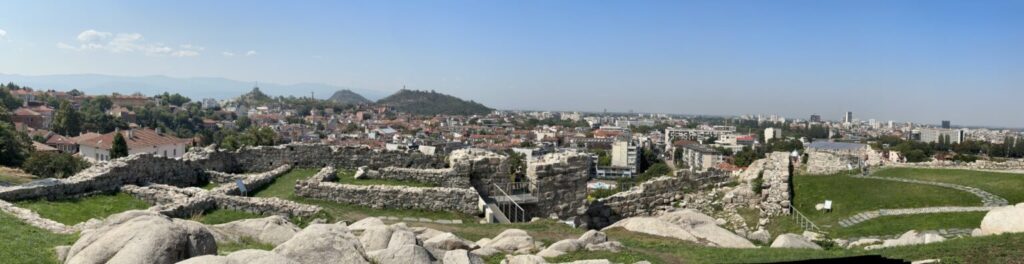
On Thursday, delegates visited Plovdiv—ancient Philippopolis—for a guided tour of its Roman heritage, including the Eastern Gateway, the theatre, and the Great Basilica with its extensive 4th-century mosaics.

The great mosaic from the Bishop’s Palace, Plovdiv, fourth century CE

A walk through the Turkish old town on the hill top culminated in a reading from Lucian’s Fugitivi, with Dimitar Dragnev voicing Heracles and Hermes overlooking the Thracian plain:

Heracles: You see those two magnificent mountains (the big one is Haemus, and the other Rhodope), and the fertile plain that spreads between them, running to the very foot of either? These three grand, rugged crests that stand out so proudly over there form as it were a triple citadel to the city that lies beneath; you can see it now, look!

Hermes: Superb! A queen among cities; her splendours reach us even here. And what is the great river that flows so close beneath the walls?

Heracles: The Hebrus, and the city was built by Philip. Well, we have left the clouds behind us now; let us try our fortune on terra firma (Lucian, Fugitivi, 25, trans.).

Looking over the Thracian plain from ancient Philippopolis

As ever, the true value of Euroclassica lies in the conversations—formal and informal—that unfold across sessions, dinners, and coach journeys. The Classical Association’s participation in this vibrant network promises fruitful exchanges and renewed energy for our discipline, wherever we are based. Next year’s conference will take place in Tbilisi, Georgia, and we look forward to continuing this shared journey of classical education and cultural dialogue.

For further details, see this news report with Professor Laes, and the Ministry of Education’s press release (both in Bulgarian, but easily translatable).

The current Euroclassica website is here. Be aware that the address may shortly change when the new website becomes operative.

©StevenHunt

Posted in Uncategorized

CI in Ancient Languages Teaching Conference

By Steven Hunt

The Faculty of Classics at the University of Cambridge hosted a conference onComprehensible Input in Ancient Languages Teaching, bringing together educators and researchers from schools and universities across Europe to discuss current developments in Latin and Ancient Greek pedagogy.

Organized bySteven Hunt, Associate Teaching Professor in Classics Education at the Faculty of Education, University of Cambridge, the conference attracted a large and diverse audience of teachers, scholars and students, both in person and over 230 online, reflecting the growing international interest in renewing methods of classical languages instruction.

Figure 1: Location of online delegates to the conference

The programme examined the application of comprehensible input (CI) and related approaches in different teaching contexts, from primary education to higher education and online learning environments.

Speakers and Topics

Professor Christian Laes (University of Manchester)
Viva voce rather than Latine loqui. From a Case in Flanders to the International Context.”
Professor Laes traced the evolution of Latin and Ancient Greek teaching in Flanders and beyond, discussing how language immersion and fluent reading have begun to replace translation and grammar-based instruction in international settings.

Dr. Mair Lloyd (Cambridge School Classics Project) and Professor James Robson (The Open University)
A Game of Two Halves: Enhancing Student Learning with Comprehensible – and Incomprehensible – Input at the Open University.”
Their joint presentation explored how the OU’s Classical Latin module integrates language acquisition with cultural study, emphasizing the role of listening comprehension and authentic materials in supporting reading fluency.

Eugenia Manolidou (Elliniki Agogi, Athens)
Ancient Greek: A new Approach to Classical Methods.”
Eugenia Manolidou presented the experiential, arts-based approach of Elliniki Agogi, School of Ancient Greek, and demonstrated how music, drama, and AI-enhanced materials can provide engaging input for primary and secondary school students.

Dr. Cressida Ryan (University of Oxford / Wolfson College)
Comprehensible Input as a Tool for Flexible and Inclusive Teaching by Design.”
Dr. Ryan discussed how CI can support inclusive pedagogy by design, particularly for neurodivergent learners, drawing on case studies from New Testament Greek.

Ana Martin (Latin Tutor Online; University of Barcelona alumna)
On Optimal Input and Actual Input: How Can We Turn Rote Memorizers into Readers?”
Martin shared practical examples from her online Latin teaching, showing how storytelling, images, gestures, and digital interactivity can enhance vocabulary acquisition and comprehension within examination constraints.

Helena Walters (Haileybury College, Hertford)
From Classroom to Cambridge: A Case Study in Comprehensible Input Teaching.”
Walters presented a longitudinal case study of a pupil’s journey from first-year Latin to successful university admission, demonstrating how CI can sustain engagement and academic achievement.

Polly Philp (Emanuel School, London)
Reading Tacitus with A Level Students: Prioritising Latin over Translation.”
Philp’s MEd research examined how focusing on Latin reading rather than translation deepens literary understanding, offering practical classroom and assessment strategies.

Jude Hedges-Robinson (University of Cambridge PGCE alumnus)
Tiered Reading and Learner Confidence in Unseen Translation.”
Hedges-Robinson presented findings from his PGCE research on the effects of tiered reading in developing student confidence and comprehension.

Steven Hunt (University of Cambridge)
As organizer and subject lead for the PGCE in Classics, Steven Hunt contributed to several discussions, highlighting the integration of classroom practice with current research in second-language acquisition.

Shared Outcomes

Across the sessions, speakers emphasized the importance of aligning ancient language pedagogy with findings from modern linguistics and educational psychology. The tone of the conference reflected a shared willingness among educators and institutions to re-examine traditional methods and adopt evidence-based strategies that make classical languages accessible without compromising rigour.

Future Steps

Video recordings of the presentations will be made available through the Faculty of Classics to facilitate continued dialogue among international colleagues.

Posted in Uncategorized