
By Olivia Page, Rory Savage and Diya Dasgupta
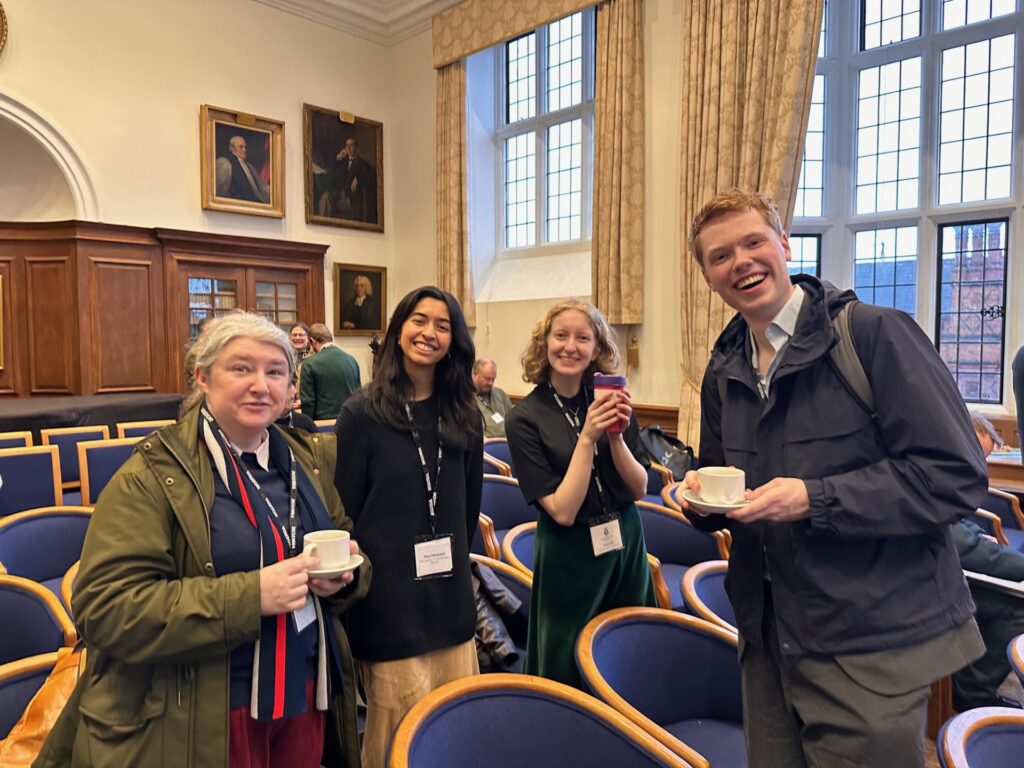
On Tuesday 27th January, three of us PGCE students from the University of Cambridge attended the Classical Association’s CPD Day for Ancient History teachers. While we have varying experiences of teaching and learning Ancient History, we all found it to be a highly valuable day that will contribute to our teaching practices across all Classical subjects. Below is a bit about us and our individual and combined reflections on the day.
Olivia: Having never studied Ancient History at school, I came to the subject as a complete newcomer this year. I have had the joy of teaching not only about my beloved Romans (I have always been a Latinist through-and-through) but also expanding my subject knowledge into teaching the Persia module at GCSE. Given my relative inexperience with the structure of the course and some of its content, I was particularly keen to attend talks on the non-Roman modules. Our PGCE cohort had also recently had a talk from Caroline Bristow on trauma-informed teaching, so I was keen to build on this through another seminar on teaching difficult topics in the Ancient History classroom.
Rory: In spite of my school offering Ancient History as a GCSE option and Latin quickly becoming my favourite subject, at age 14 I wasn’t sufficiently convinced to study the Ancient World outside of Rome and instead opted for Modern History. Seven years and a Classics degree later, having spent the majority of my undergrad picking modules specifically focused on Ancient History, I was intrigued by the CPD day’s opportunity to look into what the course involved and what experienced teachers had to say about it.
Diya: As someone who had the joy of both doing the Ancient History GCSE and having the opportunity to teach some Ancient History lessons at my first placement, I was eager to continue developing my understanding of this wonderful subject and how to teach it. The content of the course is exciting and engaging – despite my current placement school not offering Ancient History, I have already had so much fun bringing the content into other settings such as the school’s Classics Club. However, Ancient History has its own challenges for students and teachers alike and so I was eager to understand how best to maintain levels of excitement and challenge for students whilst also preparing them for their final exams.
Olivia: My first talk was given by Milan Jayasuriya, who explored how Ancient History topics can be introduced at Key Stage 3 through student-led creative projects. The seminar focused on providing structure, since the quality of student work tends to be variable without clear guidance. Suggestions included providing planning sheets and workshops on research skills (particularly for Year 7), modelling expected outcomes and treating the project as a formal assessment. As I will be working with a Year 9 class on a similar creative project later this year, this seminar provided me with some great ideas for providing the right balance of freedom and support to ensure students produce their best work while priming them with the skills they need for Ancient History GCSE.
Rory & Diya: The first talk we went to was given by Tara Atkinson (Diya’s old school teacher!) and looked at supporting SEND and low-attaining students with the dense source and knowledge requirements as well as the often technical exam-technique of GCSE Ancient History. There was very clearly a consensus from teachers about key areas of difficulty including learning names of people and places; knowing how to structure answers effectively; and knowing which information to bring into essay questions. The talk then moved to solutions including providing glossaries for set texts, reading passages out loud to improve pronunciation, consistently reminding students of topics covered to keep information fresh and modelling exam responses. The collaborative structure was incredibly useful for comparing experiences with other teachers and appreciating what the real challenges are for students, and many of the suggestions given were applicable to other Classical subjects and our pedagogy more broadly.
Olivia: The next seminar was delivered by Alex Ziegler and focused on teaching the Alexander the Great module, although the strategies discussed were applicable to all modules. The seminar discussed common student pitfalls and offered practical class exercises and revision tools to address these, including a ‘Who Said What’ chart and annotating visual sources in workbooks. Moreover, the suggestions for additional events to cover beyond the curriculum were particularly useful, and suggestions for points of comparison and discussion were provided to help us, as teachers, better enrich our students’ curriculum.
Rory: My second seminar of the day was delivered by Danny Pucknell and focused on using additional material sources for the Roman Period Study at A level to better communicate the historical narratives involved. A series of prescribed sources of Roman emperors were shown alongside images not featured in the specification, with differences between them providing springboards for discussion about changing attitudes and motivations. The use of images of emperors at different points in their life, whether Tiberius’ shift towards a Julio-Claudian appearance or Nero’s move away from one, was a powerful visual aid to understand events and to support students’ critical thinking. I felt that these additional sources could help students to strengthen their own approaches and insights and are again something I will integrate into my teaching in general.
Diya: The second seminar I attended was delivered by Dave Midgley on Adaptive Teaching, something which has been a major focus of our PGCE course. There’s a variety of ways to practice adaptive teaching in-class and I was eager to learn how it can be put into practice specifically for ancient history. In the seminar, I found the tiered topic recall exercise really useful. The activity involved students generating ideas about a particular source, topic, or event in tiers: one for specific information about the topic, one for wider topic areas it fits into, and one for the even wider picture it fits into. The key is in the delivery: a teacher, with the aid of a visualiser, can fill out the tiers together with their students. This seems like a great way to actively respond and adapt to the ideas of students and model the process at the same time. Plus, a task like this can be integrated into a variety of lessons, whether for revising content or considering points for longer essays.
Next, we all came back together to listen to a talk from Dr Campbell Price on interpreting Egyptian art. The talk was full of thought-provoking statements about the origins of Egyptologists’ scholarly interests in Egypt and about the imposition of modern standards of artistic excellence on the ancient world. Yet, the part that most stuck with us was Dr Price’s discussion of Hatshepsut. We have all seen how girls’ faces light up when they learn about powerful, famous women from history, so we are so keen to share the information from this lecture with our students. We also thought there was an interesting point of discussion to be had regarding the shift from female- to male-coded representations of Hatshepsut during her reign, and what it can tell us about perceptions of the fixity of gender in Ancient Egypt. This is again a topic our students are very interested in, so we found this to be a deeply insightful and valuable discussion.
All three of us then elected to join the discussion on teaching traumatic events in Ancient History led by Sarah Rix-Drummond and Gill Haugvik as our final seminar. This session was a combination of suggestions for wider pedagogical practice, direction towards key resources, and focusing on how to teach the rape of Lucretia. We then ended with a discussion where all attendees were encouraged to share how they manage difficult topics in the classroom – very valuable for us as developing teachers.
Finally, at the end of the day, we were invited to consult on redeveloping the GCSE period studies and question types in light of upcoming examination reforms. While we, with our relatively little experience, did not end up contributing to the discussion all that much, it was pleasing to know that teachers are being consulted on these changes, and the discussions were helpful in highlighting the questions and areas where students struggle the most, so that we can adapt our future teaching practice to focus on developing these key skills.
Overall, this was a great day for all of us! It provided a fascinating insight into the subject, communicating lots of useful advice, much of which will hopefully improve our teaching practice even beyond Ancient History. The day was also a lovely opportunity to meet lots of fantastic teachers (including some from our old schools) with a really motivating love of the subject and of education. Thank you so much to Harrow for hosting, catering and showing us all around your beautiful campus and to the Classical Association for providing such an insightful and well-organized day. We look forward to next year!
Recent Comments