The Nabataeans were the longest standing client kingdom in the Roman Near East. Client kingdoms were found across the Empire and were ruled by a rex socius et amicus populi Romani, which enabled Rome an effective method of control over its more distant provinces. As local rulers appointed by Rome, these kings served a dual purpose as both allies and political puppets. Their royal insignia was the Hellenistic diadem popularised by Alexander the Great and in turn their coin portraits typically depicted them in the guise of Hellenistic Kings. There were no exact guidelines for being a client king, with each ruler displaying various levels of ‘Romanophillia’ (a brilliant term coined by my supervisor, Dr Andreas Kropp), but many sent their sons to reside at the imperial court, creating opportunities for future leaders to network and to serve as insurance of their loyalty; some sent regular embassies, held festivals in honour of the Emperor and even depicted the Emperor on their coinage. The Nabataeans, however, sat at the opposite end of the spectrum – Aretas IV (9 BCE – 40 CE), defied convention and instigated a change in the face of Nabataean coinage that would last until the Kingdom was annexed by Trajan in 106 CE.
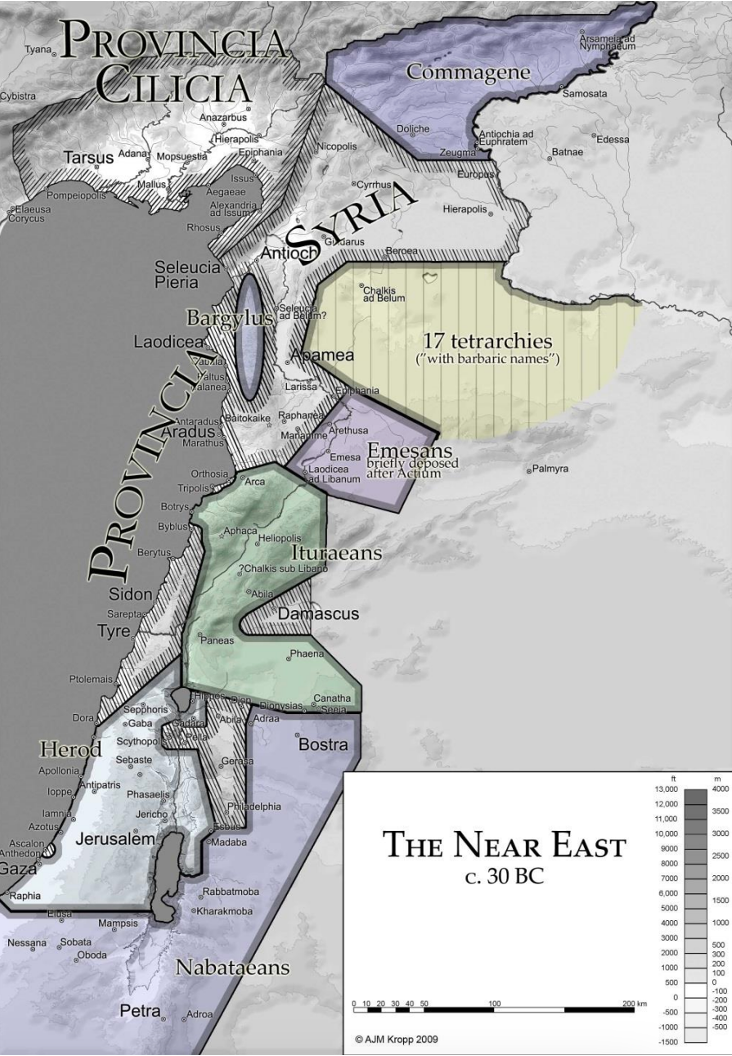
When his predecessor died, Aretas was appointed King without following the protocol of asking the permission of the Emperor. This initial blunder put a strain on the rulers’ relationship, and only after a series of complex negotiations was Aretas allowed to retain his new position. Likely to placate Augustus, his early coin issues followed custom, with the King slightly emulating the Emperor through a cropped Julio-Claudian hairstyle, albeit with a distinctly Nabataean style. This initial obedience however was short-lived. By the tenth year of his reign, Aretas had grown out his locks and swapped out his traditional diadem for a laurel wreath – the ultimate symbol of Roman imperator-ship. No other client king had dared to wear one. Though we have no sources to confirm it, this move can only be imagined to have caused further aggravation. 18 CE marked the debut of a new type of headwear, a different diadem that broke away from all prior convention. Alongside his controversial laurel wreath, the king wore a triple banded headband.
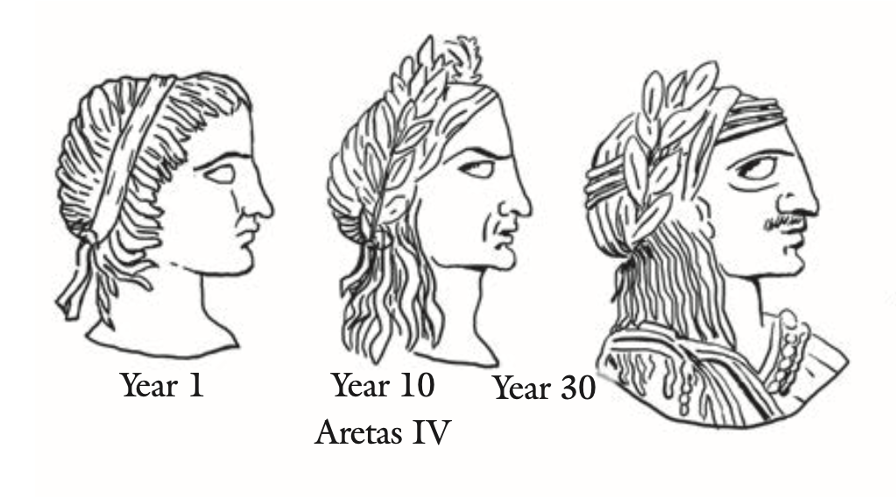
.Source: Kropp, A. (2013), Images and Monuments of Near Eastern Dynasts, 100 BC – AD 100 (Oxford), 23.
Although a precedent had already been set for stacked headwear during the Hellenistic age, this was a unique choice. Having no precedent in the Arabian peninsula, it was borrowed from the Kings of Parthia who had worn a ridged style diadem since the reign of Mithridates III (57-54 BCE). Parthian inspiration was not limited to headwear, with a simultaneous shift in costume. In place of a chlamys, Aretas was portrayed on coinage wearing a wide V-necked tunic borrowed from Parthian royal attire. The garment was decorated with ornate embroidery or pearls, represented by circular rowed patterns. Under their tunics, Parthian rulers wore trousers, a foreign concept to the Graeco-Roman world. Although no coin minted by the Nabataeans depict a trousered monarch, a Roman denarius struck in 58 BCE shows a trousered Aretas III.
The everyday appearance of Aretas probably resembled the Shami statue (50 BCE –150 CE), with which his coin portraits bear striking similarities. The figure is long haired and has an almost clean-shaven face paired with moustache. These too were alien to the Romans but frequently found across the Near East. The statue illustrates a ridged diadem consisting of seven bands – a number that excels both those shown on Parthian or Nabataean coin portraits.
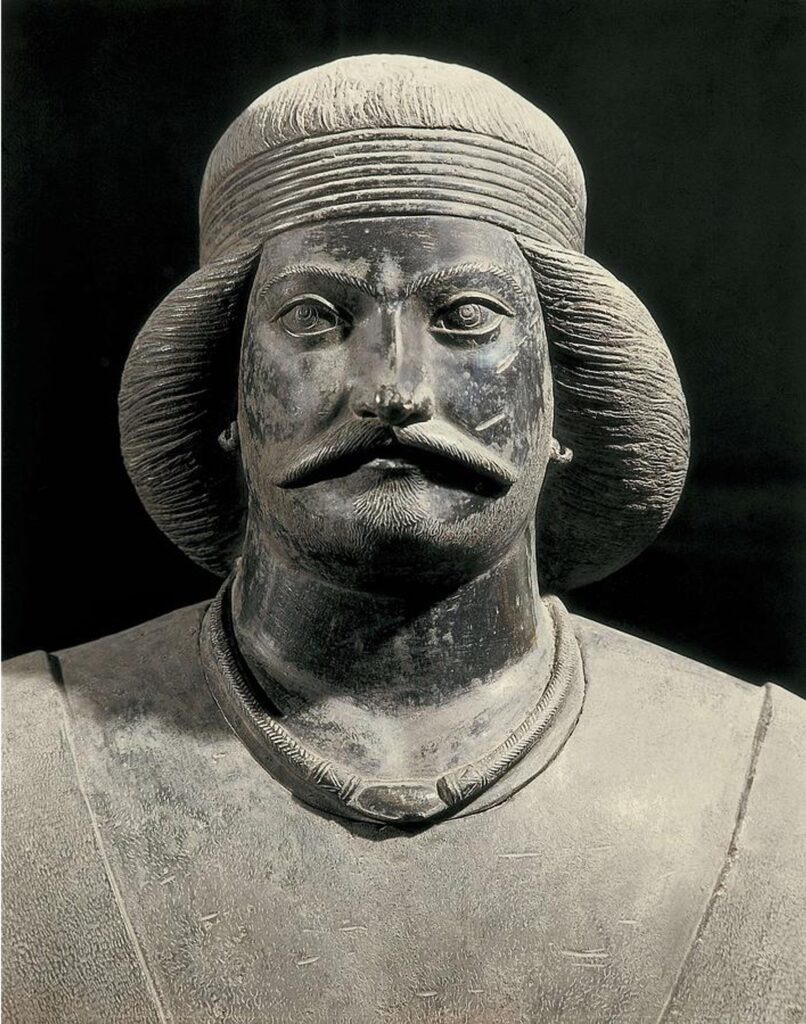
Bronze statue, circa 50 BCE- 150 CE, found at Shami. The man wears a Parthian diadem. From Wikimedia Commons (2023).
Only one account noting a Nabataean king’s appearance exists, recorded by Strabo quoting Athenodorus, who visited the royal court at Petra between 63 – early 20s BCE. The King wore similar clothes to the other men present; no tunics and “girdles about their loins”. In fact, the only symbols of status were purple slippers – a colour associated with royalty for over a millennia. The episode suggests that Aretas IV likely did not don headwear in his everyday life, perhaps showing its appearance on coinage functioned as a political message to outsiders rather than anything to do with how he was perceived by his own people. A full-length portrait of Aretas wearing cuirass and holding a spear was struck in circa 16 CE. Showing him in the guise of a Hellenistic king, it has been overlooked by scholarship. Its similarities with a relief from Dura Europos depicting Seleucus I Nicator in similar military dress are marked. Interestingly, the coin appears to be a special issue, perhaps minted in commemoration of his wedding with his second wife Shuqaylah. Therefore, Aretas IV probably never wore this outfit save for possibly special occasions.
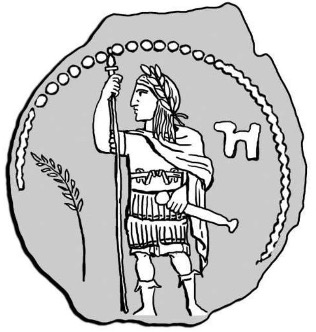
A drawing of a bronze coin of Aretas VI, showing Aretas in military cuirass with a spear (circa 16 CE), by Andreas Kropp. Source: Kropp, A.(2013), “Kings in Cuirass – Some Overlooked Full-Length Portraits of Herodian and Nabataean Dynasts”, Levant, 45 (1), 49.
The most transformative element of Aretas’ portraits is his hairstyle, which I believe reflects him embracing his real image. Perhaps the short hair initially shown never existed at all, and it was a political tool to appease Rome. Then, once comfortable and established in his position, he felt able to reject convention, wearing his hair as he typically would, in a style established on the earlier coinage of Northern Arabia.
Considering the target audience of the material assists us in determining the motives behind the rebrand. Locally produced coinage would not have been legal tender outside of Nabataean territory so the primary intended consumer of the new image must be understood as the Nabataean people themselves. The King appears to have had a good relationship with his subjects, with the epithet “who loves his people” present on coinage. This reflects his priorities, where instead of being a friend to the Roman people, his loyalties lie with his community. Almost all Nabataean coinage rejects the conventional use of Greek or Latin. Rather, they used their dialect of Aramaic and their system of dating that denoted the year of the King’s reign. This retention of their own language indicates a clear desire to preserve their cultural identity, even long after Aramaic stopped being spoken in the everyday lives of Nabataeans, and this can be compared to civic coinage at Tyre.
The incentive to rebrand himself was a clear sign to Aretas’ people that his reign marked a new age for the Nabataeans. The shift in appearance was never an implicit rejection of Hellenism, but rather a refusal by Aretas IV to play the role of a Hellenistic king forced upon him by Rome. He quite literally removed the costume of the character he was being groomed to portray, and instead forged his own path and royal identity. Beginning with his bold move away from the Hellenistic diadem, Nabataean headwear set their wearers apart from the other client kings of the Roman Near East. By modelling himself on both the royal image of the Parthians and the Imperial image of Rome, Aretas IV established himself as their equal, with the insignias firmly understood by all players. Therefore, by choosing his own new cross-cultural royal emblem, Aretas IV rebranded himself, and his dynasty, as a different kind of Roman client king.