There were exceptional pieces in the Open category by runners-up Sieve Bonaiuti, Karan Chambers, Alexis Deese-Smith, Freya Jackson and Sihle Ntuli. The former NZ Poet Laureate Selina Tusitala Marsh has shared with us some comments on the top three placed poems in this Original category:
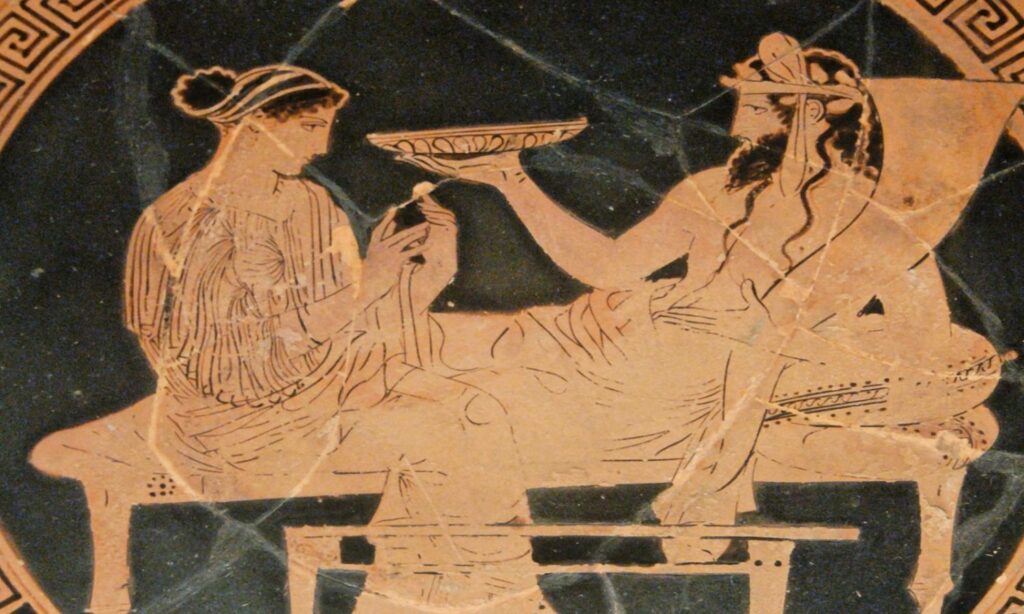
Persephone and Hades Kylix, ca. 430 BC, Attributed to the Codrus Painter, The British Museum, London
First Place – Emily Lord-Kambitsch
Pluto’s Wife in Transit is a powerful and haunting retelling of the Greek myth of Persephone and Hades that deserved to win the competition. Emily employs a range of poetic techniques to bring Persephone’s story to life in a fresh and compelling way. The use of first-person narration gives the poem an intimate, confessional tone, allowing readers to connect deeply with Persephone’s experiences and emotions. The language is vivid and sensory, from the “wet blanket gardenias” and “stinking goats” of the underworld to the “glittering frost” and “fragrant bed” of the world above.
Throughout the poem, Emily uses striking imagery and metaphor to explore themes of power, abuse, and the cyclical nature of trauma. Hades is depicted as a sinister, shadowy figure, taking on various guises – the “lone wolf in aviator shades,” the “peace officer without a badge,” the “chief executive” – that speak to the insidious and pervasive nature of abuse. The image of Persephone carving “channels in the cave walls” is a powerful symbol of her struggle to assert her agency and identity in the face of oppression.
Listen here to Pluto’s Wife in Transit, read by Professor Sharon Marshall:
The poem also grapples with the complex relationship between Persephone and her mother Demeter, capturing the pain and ambivalence of a bond strained by trauma and separation. The poet’s use of repetition, particularly in the refrain “I always come back,” underscores the cyclical nature of Persephone’s journey and the inescapable pull of her fate. One of the most striking aspects of the poem is the way it connects the myth of Persephone to contemporary experiences of gendered violence and abuse. The references to “X-ray vision of a woman’s viscera” and the various manifestations of Hades in modern life serve to highlight the ongoing relevance of the myth and the urgent need to confront and challenge these patterns of harm.
Overall, Pluto’s Wife in Transit is a tour-de-force of mythic reimagining, one that combines masterful poetic craft with unflinching insight into the depths of human experience. Through its vivid language, intimate voice, and thought-provoking engagement with contemporary issues, the poem invites readers to see the story of Persephone in a new and profoundly resonant light. It is a truly deserving winner of the competition.
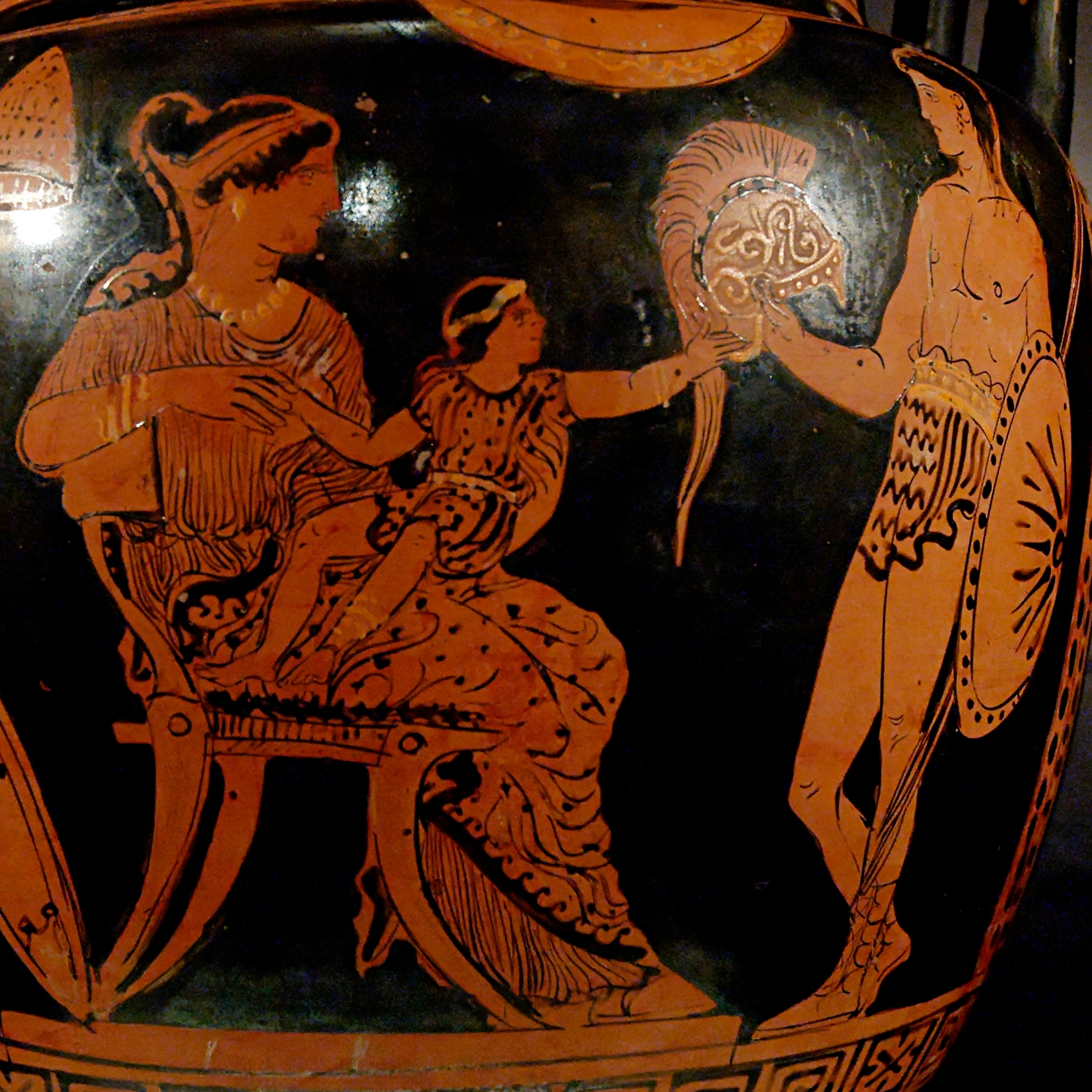
Apulian red-figure column-crater, ca. 370–360 BC. From Ruvo. Stored in the Museo Nazionale of the Palazzo Jatta in Ruvo di Puglia (Bari)
Second Place – Rachel Burns
Hector of County Durham is a deceptively simple yet remarkably effective poem that reimagines the Greek mythological figure of Hector in a modern setting. Its apparent simplicity belies a deep and nuanced engagement with the source material. The poem’s language is straightforward and unadorned, eschewing elaborate metaphors or complex syntax in favor of clear, concrete imagery. This simplicity, however, is precisely what gives the poem its power. By grounding the story in a specific, recognizable world – the “Dun Cow,” the “corner shop,” the “milk float” – the poet makes the myth feel immediate and relevant, inviting readers to see echoes of these ancient archetypes in their own lives and communities. The narrative of the poem unfolds through a series of tightly focused, almost cinematic scenes. Rachel’s use of enjambment and varied line lengths creates a sense of momentum and tension, drawing the reader into the story and heightening the emotional impact of each moment. The spare, economical language heightens this effect, allowing the reader’s imagination to fill in the gaps and invest the story with their own experiences and associations.
Throughout the poem, Rachel employs subtle but effective poetic techniques to create a sense of atmosphere and suggest deeper themes. The image of the “blood moon” and the “starlings, peck[ing] holes in the silver tops” of the milk bottles, for example, creates an eerie, unsettling tone that hints at the darker aspects of the story. The use of alliteration, as in “bottles clinking on white-bleached steps,” adds to the poem’s aural richness and sense of musicality, making the language itself a source of pleasure and engagement. Perhaps the most impressive aspect of the poem, however, is the way it engages with and subverts the conventions of the Hector myth. By casting Hector as a kind of video game hero, “satisfied he is still top of the leaderboard,” Rachel suggests the ways in which these ancient archetypes continue to shape our cultural narratives and ideals of masculinity. At the same time, the poem does not shy away from the darker aspects of the myth, hinting at the ways in which women’s bodies and agency are often violated and denied.
The apparent simplicity of the poem, then, is not a weakness but a strength. By stripping the language and narrative down to their essentials, the poet allows the underlying themes and emotions to shine through more clearly. The result is a poem that feels both timeless and urgently contemporary, a powerful reminder of the enduring relevance of these ancient stories.
In the end, it is this combination of simplicity and depth, of clarity and complexity, that makes Hector of County Durham such a remarkable poem. Through its vivid language, skillful use of poetic techniques, and thoughtful engagement with the source material, the poem invites readers to consider the ways in which myth and reality intersect, and to find new meaning and resonance in these timeless tales.
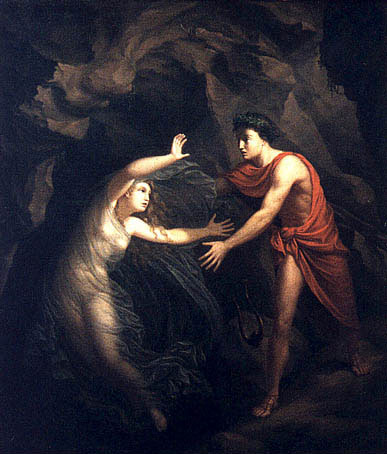
Orpheus glances back at Eurydice, 1806 oil painting by Christian Gottlieb Kratzenstein Stub
Third Place – Jessa Brown
Heurodis Began to Wake is a captivating and experimental retelling of the Greek myth of Orpheus and Eurydice. The poet takes an innovative approach to the classic tale, weaving together elements of language, mythology, and personal identity. One of the most striking features of this poem is its unique use of language. Jessa employs a mix of English, Greek, and Proto-Indo-European words, creating a linguistic tapestry that reflects the ancient origins of the myth while also making it feel fresh and contemporary. The fragmented lines and unconventional punctuation add to the sense of disorientation and transformation that Eurydice experiences in the underworld.
The poem is rich in allusions and references, from the “Otherworld” and “Hades” to “Philomel” and “Pandora.” These mythological touchstones serve to situate the poem firmly within the realm of Greek mythology, while also allowing the poet to explore broader themes of love, loss, and identity. Throughout the poem, the voice shifts between first and third person, blurring the boundaries between Eurydice and the narrator. This creates a sense of fluidity and interconnectedness, as if Eurydice’s story is part of a larger tapestry of women’s experiences. The tone is by turns haunting, defiant, and mournful, capturing the complex emotions of a woman caught between life and death, love and betrayal. Jessa employs a range of poetic techniques to convey these themes, from the use of alliteration and assonance to create a sense of musicality, to the repetition of key words and phrases to emphasize Eurydice’s struggle for autonomy and voice. The final stanzas, in particular, are a powerful declaration of independence, as Eurydice asserts her own identity apart from Orpheus and the myth that has defined her.
Overall, Heurodis Began to Wake is a stunning and original take on the Orpheus and Eurydice myth, one that challenges our assumptions about language, gender, and the enduring power of storytelling. Through its inventive use of form and language, the poem invites us to consider the ways in which we are all shaped by the stories we inherit, and the ways in which we might reimagine them for ourselves.

If you’ve been inspired by the writing and analysis of these poems, you might want to enter one of our future competitions – there are more launching soon! Every year our Omnibus magazine runs the Sam Hood Translation Prize (as well as an essay prize), which you can read more about here.