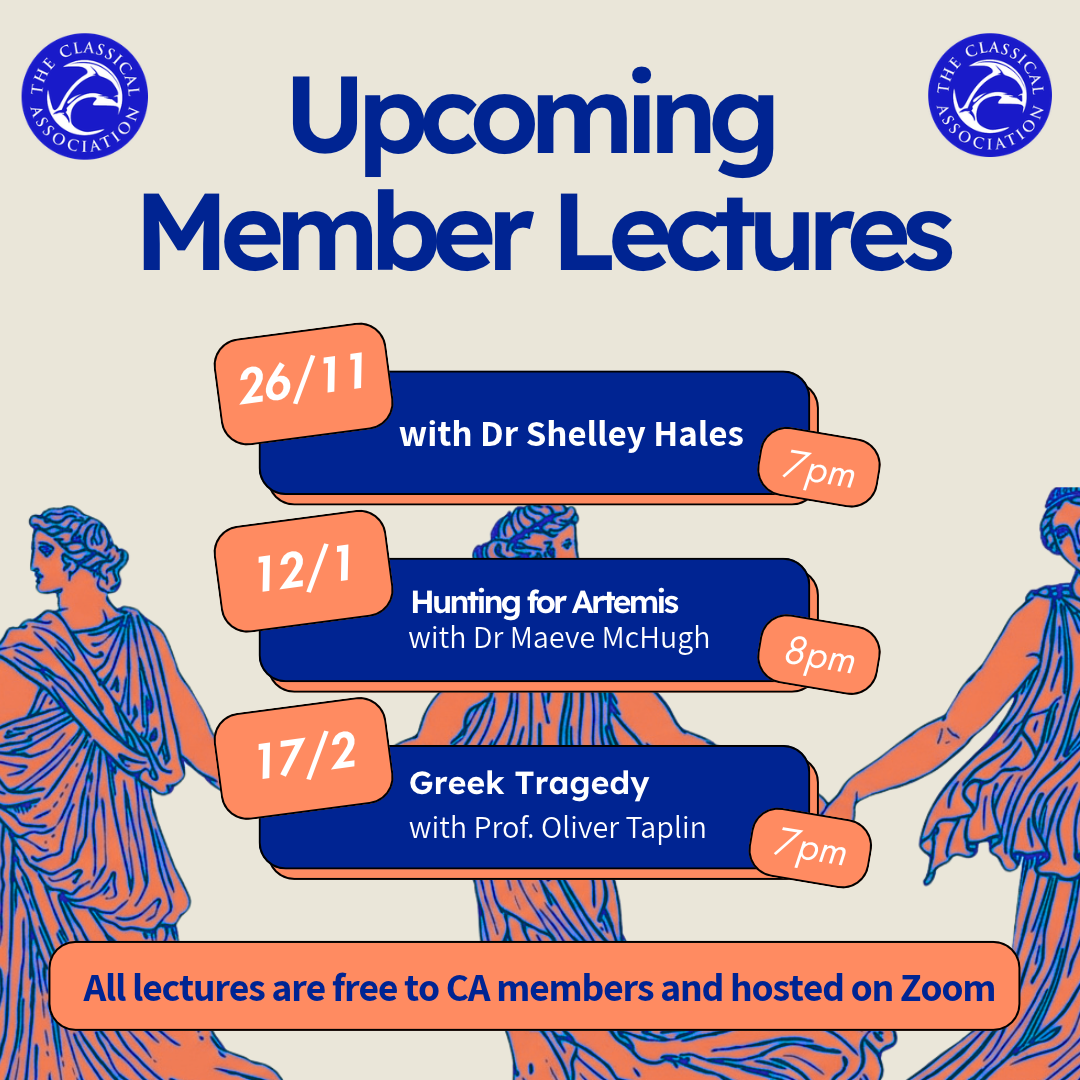
As part of our Celebrating Classics Campaign, we launched a brand new competition which was open to everybody, across the world, and celebrated how and why we study the ancient past. Scroll down to read the guidelines for this Competition, which is now closed, or read the Winning Entry!
Why is Classics Important?
Entries in our U25 Write, Speak, Design Competition will be judged in three separate age categories:
12 and under (Junior)
13-18 (Inter)
19-24 (Senior)
How do I enter?
You can enter either as an individual OR as a team of two. You must tick the appropriate box on the entry form and all entrants must be from the same age category.
To enter, you must:
- read the Rules below carefully
- complete this entry form before the deadline (23:59 GMT on 31 January 2025)
- submit your response to the question ‘Why is Classics Important?’
Please complete the form and submit your response at the same time to ensure your entry is correctly processed.
Your response can be ONE of the following:
- A written manifesto of 500-2000 words (sent as a PDF)
- A poster, which can contain up to 500 words, as well as images (sent as a PDF or jpg)
- A video presentation of maximum 15 minutes (sent as a link to an unlisted YouTube video)
Following the instructions on the entry form, your responses must be sent in an email to engagement@classicalassociation.org. In your email you must state your name(s), age and age category, and the type of your response (e.g. manifesto/poster/presentation).
Who are the judges?
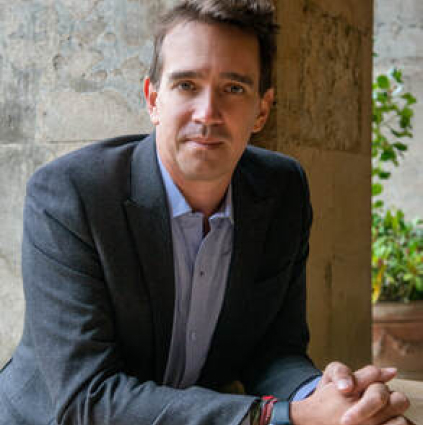
Professor Peter Frankopan
Peter is an internationally renowned historian, author and broadcaster who has caught the imagination and fascination of a wide audience with his ground-breaking books The Silk Roads: A New History of the World (also published for children) and The Earth Transformed: An Untold History. He is a Professor of Global History at Worcester College Oxford and the Director of the Oxford Centre for Byzantine Research. He is also the Chair of the Orwell Prize for Political Writing and the recipient of the 2024 Classical Association Prize. Peter presents the popular podcast, Legacy, with Afua Hirsch.
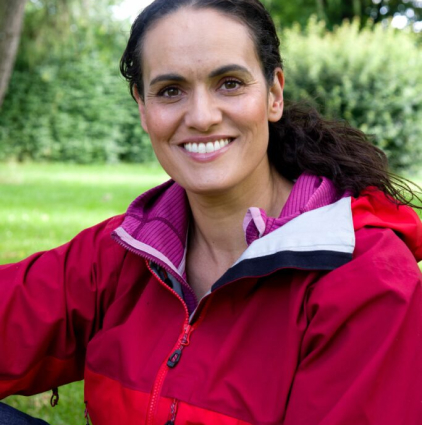
Dr Mary-Ann Ochota
Mary-Ann is a broadcaster and author specializing in anthropology and archaeology. She’s a familiar face on TV programmes like History Channel’s Ancient Impossible and Smithsonian’s Mystic Britain and she works on radio, podcasts, magazines and book projects too. Her most recent book, Secret Britain: Unearthing Our Mysterious Past reveals the histories of sites and artefacts from around Britain. Her work is usually about making academic and technical information mean something to the public – whether that’s to inform, influence or entertain.

Sana Van Dal
Sana is the CA’s Grants Officer and currently the Head of Classics at Trinity School in Croydon. She studied Classics at the University of Cambridge and after a short stint teaching English in France, she returned to London where she pursued a career in Public Relations. Having decided to leave the corporate world, she gained an MA in History of Art from University College London in 2014 and then a PGCE in Latin with Classics in 2016. She has been working as a secondary school teacher ever since, and she is particularly interested in the potential of Classics to raise discussions of EDI issues, and passionate about helping students from all backgrounds feel included in their study of Classics.

Louisa Searle
Louisa is the Director of Education for the English-Speaking Union. She began her career as a secondary school teacher, teaching English Literature & Language in North London as part of the Teach First programme. She left the classroom in 2014 to co-found and then lead the youth philanthropy/social action charity First Give, before joining The English-Speaking Union in June 2024.
What do I win?
More than £2000 prize money will be shared between winning entrants in the Write | Speak | Design Competitions. The winner of each age category will receive a special prize and shortlisted entrants will receive digital certificates. International entrants are also eligible for prizes.
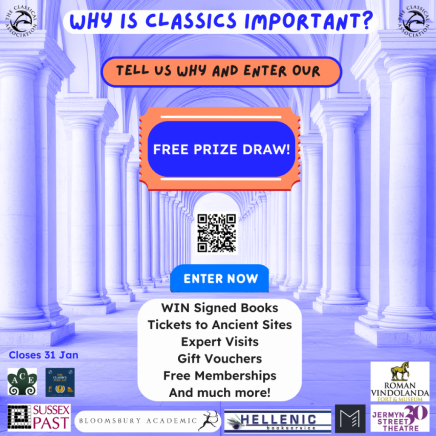
Additionally, all entrants will be entered into our Prize Draw from which random winners will be selected.
Some of the top entrants overall (this might be an individual or a pair) will be selected to present their poster/manifesto/presentation at the Competition Final which will take place in March 2025 in London.
The finalists will receive a complimentary online mentoring session with our Judges to help them prepare for the Final. The presentations at the Final may be recorded and shared afterwards. Further details of the arrangements for the Competition Final will be available after entries close.
The Rules
- The Competition is completely free to enter and you don’t need to be a member of an educational institution or of the Classical Association to take part. You can be based anywhere in the world. Entries should be submitted/presented in English (quotes etc. may be their appropriate language), however, posters in any language will be permitted if this would otherwise prevent the entrant from entering the competition. In this case, an accompanying translation into English of all text should be supplied.
- Your response must clearly answer the question – Why is Classics Important? You might give a personal interpretation i.e. why Classics is important to you, but you must also consider the place and importance of Classics in the modern world.
- You should include at least three distinct reasons when answering the question, and you should consider how Classics could be given greater importance in the modern world.
- You must complete all of the entry requirements and enter the appropriate age category.
- Your work must be your own and free from plagiarism.
- You must submit before the entry deadline (23:59 GMT on 31 January 2025). We will not accept late submissions.
If you know when you enter the competition that you will not be able to attend the Final in person please make sure that you declare this on the entry form. There may be the opportunity to present remotely but we hope that the winner will be able to present in person.
- MANIFESTO
If submitting a manifesto, you may include captioned images and/or infographics – these words will not count towards the overall word limit of max 2000. If you are referencing source material, please include a bibliography of your sources at the end (not included within the word count).
Word counts under 500 will not be considered for the competition.
POSTER
If submitting a poster, you must submit either a PDF of the digital poster or a photograph (.jpg form) of the physical poster, in which all parts of your poster can be clearly seen. Do NOT attempt to send the physical poster to the CA.
- PRESENTATION
If submitting a video presentation, this may take the form of a mini lecture, a spoken word piece, or an edited short film or animation.
If you are entering as a pair, you must both be heard on the presentation and both be prepared to present at the Final.
Video entries will be judged upon the quality of the content and the delivery of the presentation, not the quality of the filming. Recording on your phone, PC or tablet is perfectly acceptable and AV equipment (e.g. projector, laptop, clicker) will be provided where desired at the Final if you are successful.
We encourage you to think about the visual impact of your presentation; if you choose to include slides or images as part of your presentation you must ensure that they are properly credited.
Your video presentation must be no longer than 15 minutes in length. We recommend it is at least 8 minutes long. Entries beyond 15 minutes will be ineligible and will not be judged.
You must upload your video to YouTube unlisted. Information about this is available here.
In the description box of your video you must state the following: ‘this presentation is an entry for the 2025 CA Competition and the views and opinions in this presentation are those of the author(s) and do not necessarily reflect those of The Classical Association’
What will the judges be looking for?
The judges will be looking for signs of creative and pragmatic thinking, originality and personal input, persuasiveness in your pitch and evidence of detailed research.
The judges will give more credit to the content of your submission than to its appearance, but creativity and attention to detail and presentation will certainly not harm your submission.
You need to tell us why you think Classics is important and you could consider what you think a ‘Classical Education’ could look like in the modern world. To find out why other people think Classics is important and what a ‘classical education’ is, explore our Resource Bank.