by Steven Hunt, representing the UK
The 2025 Euroclassica Annual Conference unfolded at the University of Sofia, under the expert coordination of Dimitar Dragnev. The opening ceremony on 19 August took place in the university’s aula, featuring welcome addresses from the Bishop of Sofia, the Minister for Education, the Principal of the University, and Associate Professor Tsvetan Vasilev, Head of the Department of Classics.
The academic programme began with two important lectures: Professor Arlene Holmes-Henderson (Durham University, UK) presented on initiatives to reintroduce and expand Classics Education in the UK, while Professor Guido Milanese (Università Cattolica del Sacro Cuore, Brescia-Milano) explored alternative methods for assessing proficiency in ancient languages beyond traditional translation (see IN-EULALIA for details).

Euroclassica delegates at the University of Sofia
Following lunch, Luigi Miraglia (Accademia Vivarium Novum, Frascati, Italy) delivered a compelling talk on the revival of Comenius-inspired Latin pedagogy in the modern era, emphasizing the importance of spoken Latin. Associate Professor Steven Hunt (University of Cambridge, UK) then led a discussion on Euroclassica’s evolving role in fostering collaboration among educators—particularly in light of emerging technologies such as artificial intelligence.
In the afternoon, participants toured the Roman remains of ancient Serdica, embedded within the modern cityscape of Sofia. Highlights included the restored city gate and a stretch of Roman streets and shops integrated into a Metro station, where tombstones and altars line the descent to the platforms. The visit was framed by Constantine’s oft-quoted declaration: Roma mea, Sardica est—“My Rome is Serdica”—a testament to the city’s historical significance. The fourth century church of S. Sofia still stands central to the city.
The following day, 20 August, began with Euroclassica’s General Assembly. After an address by President Professor Christian Laes (University of Manchester, UK), the meeting covered financial updates, outreach proposals to Albania and Moldova, and plans for a new website to enhance networking and event dissemination. Discussion also focused on the journal Cursor, including an article by Steven Hunt on PGCE didactics, and a vote confirmed continued use of Twitter/X for communication.
Afternoon sessions featured presentations by students from Dimitar’s school and Sofia University, alongside Bulgarian educators, who shared insights into the current state of Classics in Bulgaria—where only two schools currently offer Latin and Greek. The day concluded with a guided tour of the National Archaeological Museum, showcasing Thracian and Roman artefacts of exceptional craftsmanship and historical depth.
A celebratory concert followed, featuring Latin works by Buxtehude and Bach performed by Collegium Lapis Lazuli (University of Sofia students), and original compositions inspired by Virgil’s Aeneid and Carmina Burana, performed by pupils of the 9th French Language High School ‘Alphonse de Lamartine’ and members of the Accademia Vivarium Novum’s Tyrtarion ensemble.
On Thursday, delegates visited Plovdiv—ancient Philippopolis—for a guided tour of its Roman heritage, including the Eastern Gateway, the theatre, and the Great Basilica with its extensive 4th-century mosaics.

The great mosaic from the Bishop’s Palace, Plovdiv, fourth century CE
A walk through the Turkish old town on the hill top culminated in a reading from Lucian’s Fugitivi, with Dimitar Dragnev voicing Heracles and Hermes overlooking the Thracian plain:
Heracles: You see those two magnificent mountains (the big one is Haemus, and the other Rhodope), and the fertile plain that spreads between them, running to the very foot of either? These three grand, rugged crests that stand out so proudly over there form as it were a triple citadel to the city that lies beneath; you can see it now, look!
Hermes: Superb! A queen among cities; her splendours reach us even here. And what is the great river that flows so close beneath the walls?
Heracles: The Hebrus, and the city was built by Philip. Well, we have left the clouds behind us now; let us try our fortune on terra firma (Lucian, Fugitivi, 25, trans.).
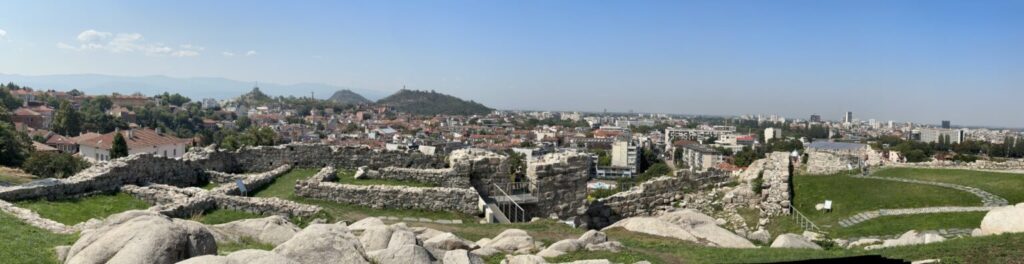
Looking over the Thracian plain from ancient Philippopolis
As ever, the true value of Euroclassica lies in the conversations—formal and informal—that unfold across sessions, dinners, and coach journeys. The Classical Association’s participation in this vibrant network promises fruitful exchanges and renewed energy for our discipline, wherever we are based. Next year’s conference will take place in Tbilisi, Georgia, and we look forward to continuing this shared journey of classical education and cultural dialogue.
For further details, see this news report with Professor Laes, and the Ministry of Education’s press release (both in Bulgarian, but easily translatable).
The current Euroclassica website is here. Be aware that the address may shortly change when the new website becomes operative.
©StevenHunt