Resistance may be futile. Resilience, however, is an educational responsibility
Artificial intelligence is rapidly becoming one of the most contested issues in education. The Department for Education is keen to explore and trial its use in schools (Hunt, 2025), while teachers are increasingly anxious about the implications of generative AI (GenAI), particularly its potential to make cheating easier and undermine the authenticity of pupils’ work. These concerns are understandable. But perhaps we need to ask a more fundamental question: should schools be teaching pupils to resist GenAI, or to become resilient and critical users of it?
There is a growing temptation to treat GenAI as something that schools must defend themselves against. Some have introduced blanket bans, particularly in relation to pupil use. Some have gone further – banning all devices in the classroom and, in exceptional cases, banning the setting of written homework out of fear that pupils will cheat.
But is this really a sustainable response? In a world in which GenAI is becoming commonplace in professional and personal life, are schools abrogating their educative responsibilities if they simply prohibit its use? And if teachers are permitted to use GenAI to plan lessons, generate resources and support their work (which in some cases they are), on what grounds should pupils be denied the opportunity to learn about it – and how to use it appropriately? Education must surely be about more than preparing young people to pass examinations. It is also about preparing them to participate thoughtfully, ethically and intelligently in the world beyond school. That means developing AI critical literacy – not simply teaching pupils how to use a chatbot, but helping them understand what it does, what it cannot do, whose interests it serves and when its outputs should be challenged. In my view, a school is disempowering its pupils if they simply ban them. And it might be said more generally that they are mistaking examination practice for teaching and learning.
The case for caution
The most immediate concern for many teachers is academic integrity. GenAI can produce convincing essays, solve problems, summarise texts and generate answers that pupils might otherwise have been expected to develop themselves. This ‘cognitive unloading’ raises difficult questions about authorship and independent learning. How do we know what a pupil understands if we cannot be sure how much of their work is their own? Of course, we may question them orally or get them to defend themselves – but such practices eat into time most teachers do not have.
The ethical questions extend well beyond cheating. The environmental costs of AI are significant. The energy and water resources required to train and operate large language models deserve scrutiny and there are also serious questions about copyright and intellectual property. Much of the material on which GenAI systems have been trained comes from written, artistic and other creative work, often without the explicit permission of its creators. What does this mean for the value we place on intellectual and artistic labour – and what messages are we sending to our pupils if we overuse them?
Then there are the epistemological and cultural problems. GenAI can hallucinate, producing plausible-sounding but inaccurate information. It can present speculation as fact and reproduce the biases embedded in its training data. Its apparent fluency can encourage a dangerous acceptance of answers that have not been checked or questioned. There is also a more subtle danger: the smoothing out of individual voices. AI-generated writing can flatten ideas, remove idiosyncrasies and produce a generic, polished version of what might otherwise have been an interesting and distinctive piece of work. It can whitewash the evidence, marginalise minority perspectives and obscure the voices of subaltern groups. It can lose the voices of the authors.
And who decides what goes into these systems in the first place? Who creates and controls the black boxes through which information is processed? What assumptions, values and omissions are built into them? These are questions about power as much as technology.
Pupils need to understand these problems. Indeed, developing the ability to recognise and challenge them should be a central part of any meaningful GenAI education.
Resistance is futile. But resilience is possible
The temptation to ban GenAI altogether is understandable, particularly when schools are already struggling with workload, assessment pressures and concerns about pupil engagement. But resistance may not be the most productive response. Banning AI does not make it disappear. Nor does it prepare pupils to navigate a world in which they will encounter it in higher education, employment and everyday life. A blanket ban risks creating a false distinction between the world of school and the world beyond it. The alternative is not uncritical enthusiasm. It is resilience: the ability to work with GenAI without becoming dependent on it, to recognise its limitations, to question its outputs and to know when not to use it. That requires teaching, modelling and practice. It cannot be achieved through prohibition alone.
Cognitive offloading or cognitive enhancement?
One of the most interesting questions concerns the relationship between AI and learning itself. Writing is often understood as a way of thinking. The process of putting ideas into words helps us organise, develop and remember them. The important question is what the technology enables us to do, and what knowledge and understanding we need to use it effectively. It is perfectly possible to learn something independently and then use GenAI to extend, test or apply that learning.
Getting the sequencing right
Pupils need opportunities to acquire knowledge, practise skills and develop their own understanding. But once they have established that foundation, GenAI can help them explore further possibilities, make connections, generate questions and approach problems from different perspectives. It can be particularly useful for pupils who do not know where to start. A chatbot might help them break down a complex task, suggest possible lines of enquiry or offer personalised advice on a piece of work. It might help a pupil identify gaps in an argument, think of counterarguments or explore an unfamiliar topic.
Language learning offers another opportunity. Chatbots can provide opportunities for conversation, practise vocabulary and grammar, and allow pupils to experiment with language in a relatively low-pressure environment. They can also provide a starting point for exploring subjects and interests beyond the immediate curriculum.
None of this means that GenAI is a substitute for a teacher. Indeed, there is good reason to be cautious about claims that GenAI can outperform human teaching. Learning is relational, social and contextual. Teachers do much more than supply information or provide answers. They recognise misconceptions, make judgements about what pupils need next, establish relationships and create the conditions in which learning can happen. Teachers often provide the ’grit’ that makes learning happen – or checks when it needs more work to make it happen. GenAI can assist with some aspects of this work, but it cannot simply replicate the whole process.
From activity to learning
There is another danger in the enthusiasm surrounding GenAI: confusing activity with learning. GenAI makes it remarkably easy to produce things. It can generate quizzes, worksheets, presentations, revision materials, creative writing prompts and interactive activities in seconds. For teachers, this offers enormous potential to develop resources quickly, adapt existing materials and explore approaches that might previously have been too time-consuming to attempt.
But the production of a resource – especially a new, glittery, shiny one. It’s not the same as the achievement of learning. An engaging activity necessarily an effective one. We have seen this before in education: the seductive appeal of the new activity, the impressive-looking resource or the lesson that pupils enjoy, without sufficient attention to what they actually remember and understand afterwards. Teachers therefore need to retain their professional judgement. The question should not simply be whether GenAI can generate an activity, but whether that activity helps pupils acquire knowledge, develop understanding and remember what they have learned. Better than before.
The particular possibilities for teachers of classics
There may be something particularly interesting here for teachers of classical subjects.
Classics is, almost by definition, an interdisciplinary enterprise. Classicists are accustomed to thinking about languages, literature, history, philosophy and material culture – often simultaneously. They work across different kinds of evidence and are used to negotiating the tensions between literary accounts, historical interpretation and material remains. This breadth of perspective may make classicists particularly well placed to engage critically with GenAI.
GenAI then becomes another resource in an already rich intellectual toolkit. It might help pupils explore different interpretations of a literary text, compare translations, generate questions about historical evidence or investigate connections between ancient and modern cultures that might not have been considered before. Iterative approaches to using GenAI – at the start, in the middle and at the end of a project might be an effective way of integrating this tool as a prompter, guide and assessor.
It might provide a conversational partner for practising Latin or Greek vocabulary, help pupils identify possible grammatical constructions or suggest alternative ways of approaching a translation. But the important point is that GenAI should add to, rather than replace, the resources we already have. A pupil still needs to learn vocabulary, understand grammar, read texts deeply and develop the ability to interpret evidence. GenAI might support these processes, but it should not remove the intellectual challenge that makes them worthwhile.
Indeed, its mistakes can themselves become useful teaching opportunities. An inaccurate translation, a fabricated historical detail or an oversimplified interpretation can prompt pupils to examine evidence more carefully and articulate why an answer is wrong. In this sense, GenAI can become not simply a source of answers but an object of critical enquiry.
Examples of practice
The AI conference held on 23rd October 2026 at the Faculty of Classics, University of Cambridge explored some of these aspects of teaching using GenAI. Dr. Imogen Caseborne, from the Digital Education Futures Initiative, examined both the promise and the limitations of GenAI. She explained how large language models generate responses by predicting statistically probable patterns rather than genuinely understanding a topic, meaning they can reproduce biases, omissions and inaccuracies. Drawing on the idea of the “AI mirror,” she highlighted how GenAI can reflect existing human assumptions back to users. At the same time, she argued that, when used critically, GenAI can provide valuable feedback, alternative perspectives and opportunities for discussion. Her presentation also raised important concerns about overreliance on GenAI, particularly the danger that students may become dependent on tools that support performance without promoting lasting learning.
The conference also showcased innovative Classics projects. Professor Esther Eidinow (University of Bristol) presented a virtual reality recreation of the Oracle of Zeus at Dodona, which enabled students to interact with AI-powered characters inspired by ancient sources. The project demonstrated how emerging technologies can make the ancient world more immersive and accessible. Teachers also shared practical classroom applications. Sian Squire (Shrewsbury College) demonstrated how GenAI can transform notes into revision resources, quizzes, podcasts, videos, and essay scaffolds, offering students multiple ways to engage with content. Justin Hobson (Riddlesdown Collegiate) showed how his pupils responded to personalised feedback from GenAI chatbots for grammar practice. Eleanor Jenkins (Howell’s School) demonstrated how she had used pupils’ practical experience of GenAI to develop their critical awareness about classical works more generally – an application as much about Classics methodology as it was about AI. Philip Harper explained the rationale for his GenAI randomiser for improving pupils’ accurate knowledge of Latin morphology. Benefits included immediate feedback, increased confidence, improved engagement and significant reductions in teacher workload, though speakers were careful to acknowledge limitations and challenges.
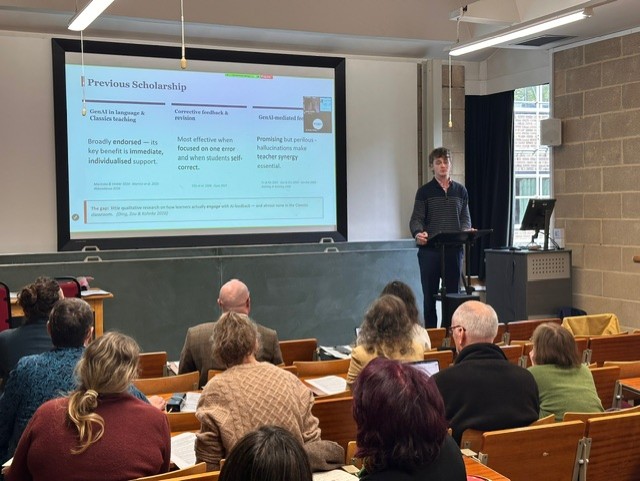
The talks are available to watch on the Cambridge Classics Faculty’s Ancient Languages Teaching and Classics Education Conferences website. Readers might like to visit examples of the work of Sian Squire on A level Athenian Democracy and of Simon Beasley (King Edward VI Five Ways) on the Exekias Dionysos kylix both made with Claude.AI. The talks will be published in the Cambridge Papers in Classics Education on the same Faculty website.

Assessment: are we asking the right questions?
Much of the anxiety about GenAI in schools is driven by examinations and assessment. If pupils can use it to produce essays, complete homework or generate answers, how can teachers be confident that the work submitted reflects their own understanding?
This is a legitimate concern, but it also exposes some weaknesses in our existing approaches to assessment. If an assessment can be completed convincingly by a chatbot, perhaps we need to think more carefully about what we are assessing and why. There is a risk that we become so focused on protecting familiar forms of assessment that we lose sight of the wider purposes of learning. Education is not simply preparation for examinations. It is also about intellectual curiosity, developing judgement, acquiring knowledge and learning how to participate in society.
We should certainly continue to assess what pupils know and can do independently. There will be times when GenAI should not be used, particularly when the purpose is to establish whether a pupil has acquired a particular skill or body of knowledge.
But we might also consider more thoughtful approaches to assessing the process of learning, rather than relying exclusively on the final product. GenAI might legitimately form part of the process without being allowed to determine the final product. This suggests a need for more varied forms of assessment: discussion, oral explanation, drafting, reflection, in-class writing, problem-solving and opportunities for pupils to demonstrate their understanding in different contexts.
It also suggests that we need to build trust and make expectations explicit. Pupils should understand when GenAI is permitted, when it is not, and what constitutes responsible acknowledgement of its use. The answer cannot simply be to assume that pupils are cheating. Equally, we should not assume that the existence of a finished piece of work demonstrates learning.
We need to recognise that the world our pupils are entering is changing. Preparing them for that world means more than teaching them how to avoid GenAI. It means teaching them how to question it, challenge it, use it responsibly and, when appropriate, put it to good purpose.
Steven Hunt
References
Hunt, S. (2025, October). Like It Or Not, AI Is Becoming Part Of School Life. Retrieved from Council of University Classics Departments Bulletin, 54.