
Dr. Jessica Clarke
Our Expert in Residence, Dr Jessica Clarke, shares some of her latest research in this member blog. These objects are discussed in further detail in her forthcoming book
A New History of Ancient Roman Theatre, available for pre-order from Liverpool University Press.
High on a shelf in the Vatican’s Museo Pio Clementino, largely overlooked by the crowds flowing through the Galleria dei Candelabri, sits a finely carved marble figure of a comic slave character. Perched just above eye level, this remarkable object (inv. 2661) receives little attention from passing visitors, and even less in current scholarship. Yet it offers a powerful and revealing glimpse into the entangled world of theatre, political hierarchies, and enslaved experiences in the ancient world.
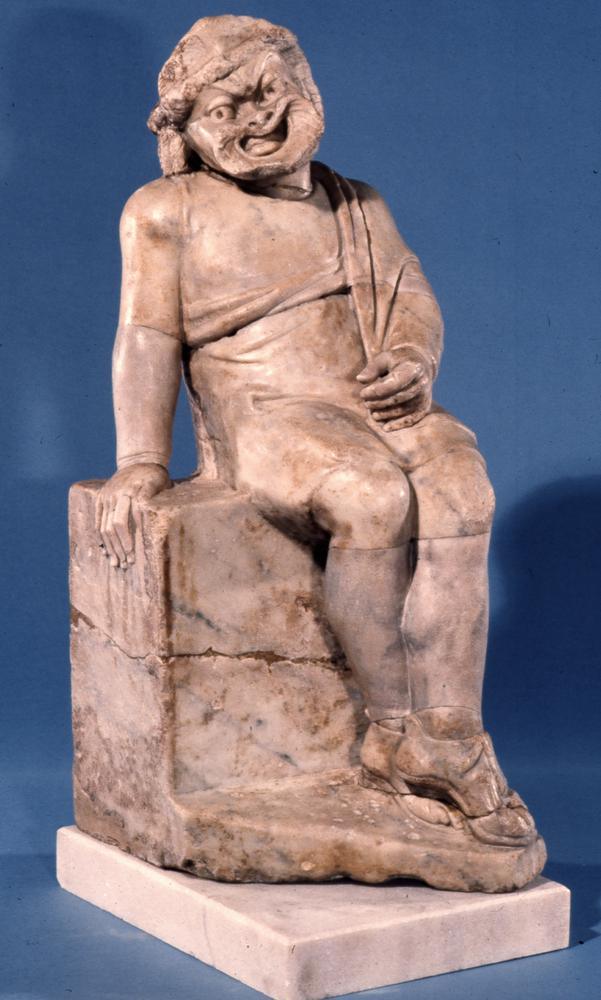
The statue, carved from high-quality Carrara marble sourced from quarries in the Luna mountains, stands at approximately 115cm tall. It depicts a familiar figure from Roman comedy: a slave character mid-performance, seated atop a large square altar. His ankles are crossed, his posture appears casual, and his right hand reaches back to support himself. A wreathed mask sits on top of his head, with sharply defined eyes, an open mouth and a visible tongue. Beneath the mask, the sculptor has carefully rendered the actor’s face, and the lips are just visible through the open mouth of the mask.
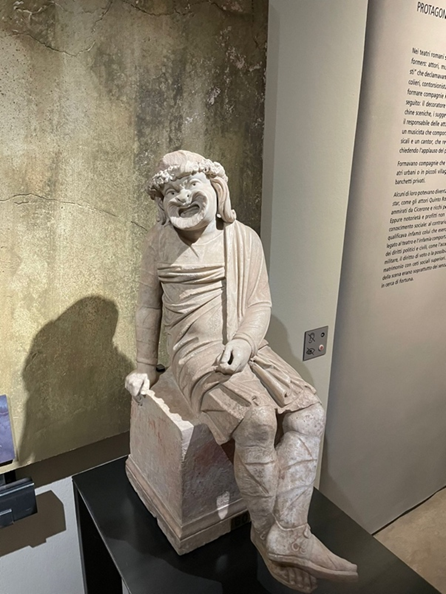

This finely executed sculpture dates to the early first century CE, a period when theatrical motifs were becoming increasingly popular in Roman domestic decoration. Yet the figure has a long iconographic history stretching back through the centuries.
From the early fourth century BCE, small terracotta figurines of comic characters were deposited in Greek tombs, likely as markers of social status and cultural taste, or perhaps as tokens of protection for the deceased to take with them into the afterlife. Among these were figurines of slave characters, seated on square bases resembling altars. One such example, now in the Metropolitan Museum of Art (inv. 13.255.13-14 and 16-28), shows a masked figure wearing a traveller’s cap, his phallus exaggerated and clearly visible between his legs – a reference to the bawdy traditions of Old and Middle Comedy.
These figurines proliferated across the Hellenistic and Roman Mediterranean, and by the first century BCE, the medium had diversified. We have a striking bronze example which is currently housed in the British Museum (inv. 1878,0504.1). It presents a comic slave character sitting on an altar with his legs crossed, his chin resting on his right hand, and an exaggerated, gaping-mouthed mask. Though the findspot remains unconfirmed, the piece’s fine craftsmanship suggests that it was intended for domestic display, such as the decoration of a lararium (household shrine) or a niche in a well-appointed Roman home.


Indeed, the Vatican statue is not the only example that has been found rendered in marble. It has several siblings that are now scattered across the museums of Europe. One has been found in Albania, coming from the theatre at Byllis, whilst another, almost identical to the Vatican statue in size, material, and pose, is now in the British Museum (inv. 1805,0703.45). This British Museum version stands 60cm tall, with a base measuring 27cm by 32cm, and it was likely produced by the same workshop, perhaps even using the same template.
We can also see these scenes of seated comic slaves rendered on Roman frescos and terracotta relief panels. One example is a wall panel from Campania, which dates to the turn of the first century BCE, and is now housed in the British Museum (inv. 1926,0324.115). The fragment shows an actor wearing a slave mask in front of a scaenae frons. He has a mantle over his shoulder and leans towards his right. Using other panels that have survived and which display the same iconography, the entire scene can be reconstructed to show how the rest of the scene would have looked.
By piecing together various examples, the scene can be reconstructed as seen in the line drawing below, created by Otto Puchstein in the early twentieth century. We can see a slave character seeking refuge on an altar in front of a house, and an angry old man rushing towards him, whilst another male character (perhaps a younger man) stands between them, evidently trying to mediate the situation.


However, despite the quantity and excellent preservation of these images, this seated slave character has received remarkably little sustained scholarly attention. When mentioned in museum catalogues and or placed on display in exhibitions, they are often relegated to the status of minor decorative items and stripped of their interpretive depth and cultural context. The Vatican statue is even sometimes mislabelled in exhibitions, so that there is no acknowledgement that the character being depicted is a representation of an enslaved individual. As a result, the social commentary embedded in these objects and their potential to illuminate ancient attitudes towards slavery, social hierarchy, and humour remains largely unexplored.
So, what exactly do these statues depict? Why does this image of a seated comic slave on an altar appear across the centuries and in different media? What was its significance to Roman audiences? Particularly those wealthy enough to commission such pieces for their homes?
The answer lies in a recurring dramatic trope from Greek New Comedy and its later adaptations in the Latin palliata of the second century BCE. In examining these images, we are looking at representations of a slave character who seeks sanctuary by fleeing to an altar, where he should (in theory) be safe from all physical harm. A particularly vivid example survives in a fragmentary piece of papyrus of the play Perinthia by Menander (POxy 855), in which the slave character Daos escapes punishment from his master, Laches, by taking refuge on an altar. Laches, enraged, threatens to burn him off and orders his other slaves to gather wood for a bonfire. The papyrus then breaks off before the resolution of the conflict.
What the scene seems to grapple with is whether the comic slave character deserves the protection which he seeks. Should an enslaved individual – even if he is a character in a play – be granted religious sanctuary at an altar? Or is this a laughable idea?
The same question can be identified in second-century BCE comedy, most noticeably in Plautus’ play Mostellaria. In the fifth act, the slave Tranio returns home to overhear his master (Theopropides) instructing the other servants to hide in the doorway with chains so that Tranio can be captured. Tranio frustrates Theopropides’ attempts to capture him by sitting on the altar just outside the front door of the house, where he can avoid being questioned. Theopropides is unable to get his slave to move from the altar (lines 1065-1125).
The scholarly consensus is that this is a deliberately farcical interaction. By placing the scene within a comedy, it seems to make a mockery of the idea that a slave could seek refuge from his master’s legal authority over him. Whilst he might try and seek refuge from physical violence at an altar, this was, ultimately, a comic idea rather than one that should be taken seriously by the audience.
A similar idea can be found in Plautus’ Rudens in which two young women owned by the pimp Labrax seek refuge in the temple of Venus. In seeking their return, Labrax asks: ‘I shouldn’t be allowed to take my own slave girls away from the altar of Venus?’ to which Daemones replies: ‘You aren’t allowed to: there’s a law among us’ (lines 723-5). In this case, we can see that the comic scene is questioning what is permitted by the owner of a slave in relation to a religious sanctuary. Is Labrax permitted to forcibly remove his slaves, or are they safe when they are at the altar?
This brings us back to the statues. Why carve this specific moment – of ambiguous asylum and unresolved tension – into stone? Why was it some popular among the Roman elites? These statues offer an opportunity to confront how slavery was normalised, and perhaps also trivialised, through comic imagery, yet they have remained largely absent from the conversations that seek to interrogate these dynamics.
These images likely served as visual reminders of the ancient social order. If an enslaved person was disobedient, ran away, and evaded punishment, then they could be pursued by their master, even, perhaps, into places of sanctuary. This was an important message in the context of homes with numerous enslaved individuals. As current scholarship is in general agreement, slave labour was essential to the functioning of a large Roman home, and slaves were continually present in daily routines.
If we consider these statutes in the context of a household inhabited by enslaved people, the images seem to hold an overt and aggressive tone, perhaps reminding an enslaved person not to try and seek their freedom. Emancipation without consent was a laughable idea in its ancient context: a piece of fiction only appropriate for the comic stage.
© Jessica Clarke