Sapere Aude: Dare to Know

Sapere Aude: Dare to Know

Read part 1 in Claire’s series here

The house is hushed. Upstairs, the children have quieted, finally relenting to sleep whilst downstairs, the chores are done, and the kitchen now darkened. It’s a precious time of day, a deep breath after the intensity of juggling full time teaching and parenting. Tiredness and easy TV beckons, but there’s a mental itch I can’t seem to ignore; once again I find myself in our spare room, hunched over a messy desk, head deep in the Classical era, and mind soaring.

When I first came across the Classical Association tweet advertising the NEC bursary for teachers, I must admit, I had my doubts. As if I had the time to do an actual A level. Who was I kidding? And yet something about it tugged at me and wouldn’t let go. I’d always had a casual interest in the Greek myths – a leftover from a bookish childhood, perhaps – but that passing curiosity had deepened into something far more serious when we started writing our English curriculum and David Didau introduced me to Simon Armitage’s translation of the Odyssey. I’d already listened to and greatly enjoyed Stephen Fry’s Mythos and Heroes the previous year, which felt like visiting with old, beloved friends. But this, this was something different, something vast and circuitous and difficult. It got into my dreams, absorbed my thoughts, at once deeply familiar and intensely strange. Once I read Armitage’s dramatization, I picked up Emily Wilson’s translation and I was hooked. I dithered and doubted my way through an application for the bursary, convinced myself there was no way I would get it… until suddenly an email appeared in my inbox saying quite the opposite. And so began eighteen months of fascinating, challenging study.

Of all the things I’d hoped I’d get from studying an A level in Classical Civilisation, probably the least expected, the most surprising, has been the heady joy of falling back in love with academic study. 30 years since I last took A levels, and here I am, properly nerding out over Homer and Virgil and, of all things, vase paintings. I have countless tabs open all the time, all filled with little segue ways and rabbit holes in Classical Studies, whether the social purpose of Attic tragedy, or a virtual reality 3D ‘map’ of Augustan Rome, or modern performances of comedies in ancient Greek. My wall above my desk is papered with post it notes and handwritten reminders, with dates, names of battles, lists of prescribed sources, quotations – one in Latin – and more recommendations for books than I’ll ever be able to read. Immersing myself in this vast, vibrant world has brought technicolour back to my thoughts, and reinvigorated my intellectual life in ways that I honestly couldn’t have imagined. In the same way some people do crosswords, or listen to complex music, or go for a run, studying Classics has become my way to unwind, something I look forward to each day and find myself impatient to get back to when the real world inevitably intrudes. I’ve finally found ‘my thing’.

And it strikes me in teaching that we so often lose our ‘thing’. It’s hard to remember our passion for our subject, or for intellectual study itself, when Year 9 won’t stop dabbing, or Year 11 constantly shout out, or Year 8 are just being very Year 8. It gets even harder when you add the duties, the pressures, the paperwork, the data, the results, the policies. Teaching is often cognitively tiring, but it’s not always intellectually stimulating. I would finish long school days emotionally and cognitively wired and wound up, but it wasn’t until I started the Classics A level that I realised the value in doing something intellectually stimulating as a way to unwind.

Professional well-being so often focuses on our physical wellbeing, whether that’s afternoon yoga or going for a walk. And whilst those things are certainly helpful, how often do we focus on our minds, on our intellectual, interior life itself? It’s certainly been my experience after twenty odd years in the profession that my inner life, my thoughts and my mind, have all too often been squeezed by my work. Sometimes that’s been incredibly exciting and enriching, but sometimes it’s because I can’t stop worrying about whether 9×3 have made enough progress, or if a certain lesson will go better tomorrow than I fear. And that’s a quick road to burnout. Turns out, doing more with my brain, finding something stimulating and interesting and different is the best way to turn off those unhelpful worries. Despite twenty years in teaching, this has been a revelation. In the eighteen months since I started the A level, I’ve found it easier, not harder, to switch off from work. Half an hour of Greek tragedy in an evening has made a far greater difference to my mental wellbeing than scrolling on my phone ever could.

And so, as we approach the summer term, and – eventually – the summer holidays, what if you found your thing? Or focused on it more, if you’re lucky enough to have already found it. What if you found that thing that doesn’t feel like more work, that invigorates instead of diminishes, that fills your cup when school has emptied it, several times over – whether that’s pottery or South Asian novels or quantum mechanics or the life cycle of certain kinds of jellyfish? And if you think your thing might be studying Classical Civilisation (and why wouldn’t it be?!), I urge you to apply for the bursary with the Classical Association – you never know what treasures you might find, deep in this labyrinth. If we want to be the best teachers, and the best people that we can, it’s time to dare to know.  

To find out more about our bursary scheme with the National Extension College, click here and apply now using this form.
Posted in Classics in Action

Athena Society: using history to tackle misogyny in schools

Athena Society: using history to tackle misogyny in schools

On Monday 14th June 2021, the CA hosted a virtual event for schoolteachers, designed to provide information, and dispel myths, about presenting at a CA conference as a teacher.

Devised and hosted by the CA’s Outreach Officer, a former schoolteacher herself, the event was a successful example of collaboration and knowledge exchange across educational phases, with both academics and teachers presenting.

Talking about gender equality has become an increasingly difficult topic that teachers are having to tackle head on at the front lines in our classrooms with little guidance or support. We know from platforms like Everyone’s Invited and the investigations of Rape Crisis UK that 90% of school age girls face sexual harassment by their peers which often goes unchallenged. We also know that there has been a concerning rise in misogynistic content which is being pushed towards young men online.

In this context, I have seen how students are shaken and want to try and understand the historical roots of how and why misogyny exists in the world, but don’t know where to start. Both male and female students often don’t feel empowered to talk about these issues amongst their peers for fear of being ‘cancelled’ on social media. For many young people, these issues seem so prevalent and systemic that they are starting to accept it as part of life.

As I teach the three subjects of Classics, History and Politics, I saw an interesting opportunity to lead on showing students how present issues are often the remnants of long shadows from the past. I was keen to find a new way to help kickstart conversations on gender equality in schools, using Classics as a way to stimulate curiosity from students who don’t necessarily study the subject. And so, the Athena Society was born!

Athena Society gives the opportunity for students to explore historical time periods and issues beyond the school curriculum. We can uncover surprising new stories that show women displaying creativity and resistance despite the boundaries imposed upon them, as well as men who have supported and helped change stereotypes. It is a space outside of lessons in a relaxed atmosphere where students set the agenda themselves, deciding on research presentations they want to do, knowing that there is a trusted adult who can guide them through sometimes difficult conversations. Here young people are able to physically listen to each other and to think critically about the media content they consume, through learning new historical information that helps them to understand where modern political issues stem from.

Students who take part in Athena Society feel empowered with knowledge and skills to ask new questions about media content and build a positive ethos across the school environment. By bringing historical context to popular culture, students can get thinking about gender equality and ways they can be actively involved in positive societal change. Changing young minds and helping them to break stereotypes by seeing their unjust historical roots is, in my view, the key to continuing the cause for gender equality. Both young men and young women have to see the importance of this and with student-led projects like Athena Society we must strive to be optimistic for a better future.

Athena Society started as a simple after school conversation in a classroom with a few students after a tragic event, but I hope to build a movement that keeps the question of gender equality alive in schools by researching historical stories and interrogating popular culture. We have grown to include students from across year groups in the school and hosted our inaugural conference in February 2023 inviting local schools to collaborate and listen to guest speakers. We began creating informative Instagram posts @athenasocietyofficial to further our reach and set up a website www.athenasocietyofficial.com including merchandise with our fabulous logo designed by one of our students. We are also engaging with our local MP, taking part in focus groups in Parliament and raising matters of women’s safety in the local area.

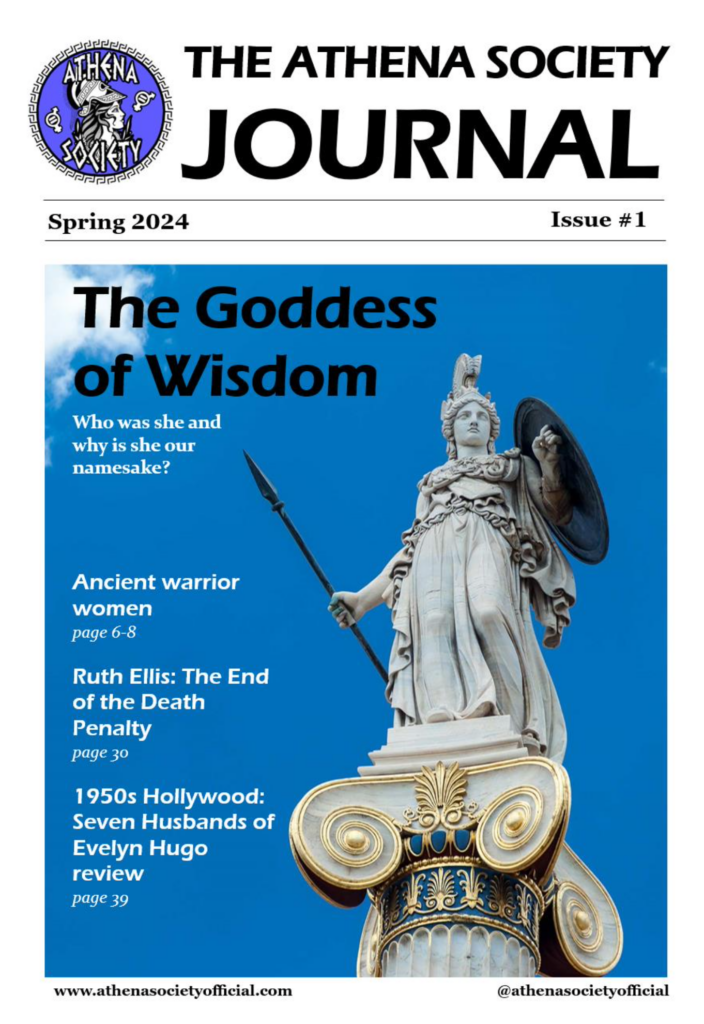
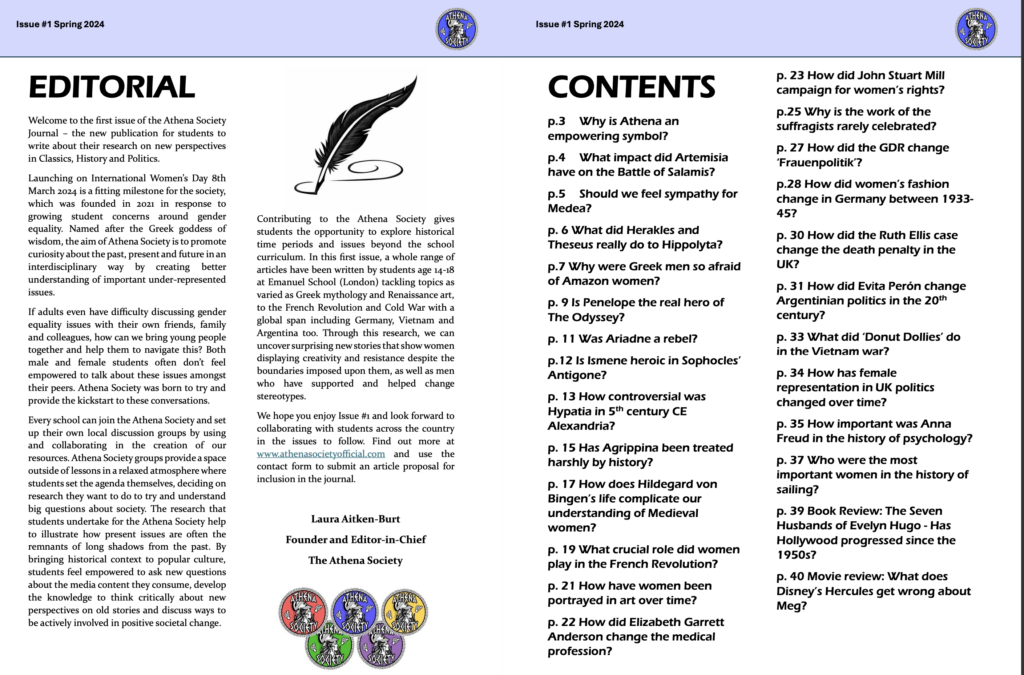
Our latest development has been to create the Athena Society Journal, launched on International Women’s Day 8th March 2024. It contains articles submitted by students on topics they have researched on feminist themes through time. The first issue tackled topics as varied as Greek mythology and Renaissance art, to the French Revolution and Cold War with a global span including Germany, Vietnam and Argentina too.

We hope that this resource will help schools across the country to start their own gender equality conversations, using Classics as an interesting way to bring students into the discussion. To join us, use the contact form at www.athenasocietyofficial.com and encourage your students to send in their ideas for our next issue of the Journal!

Posted in Classics in Action

Wild Visions in Sheffield

Wild Visions in Sheffield

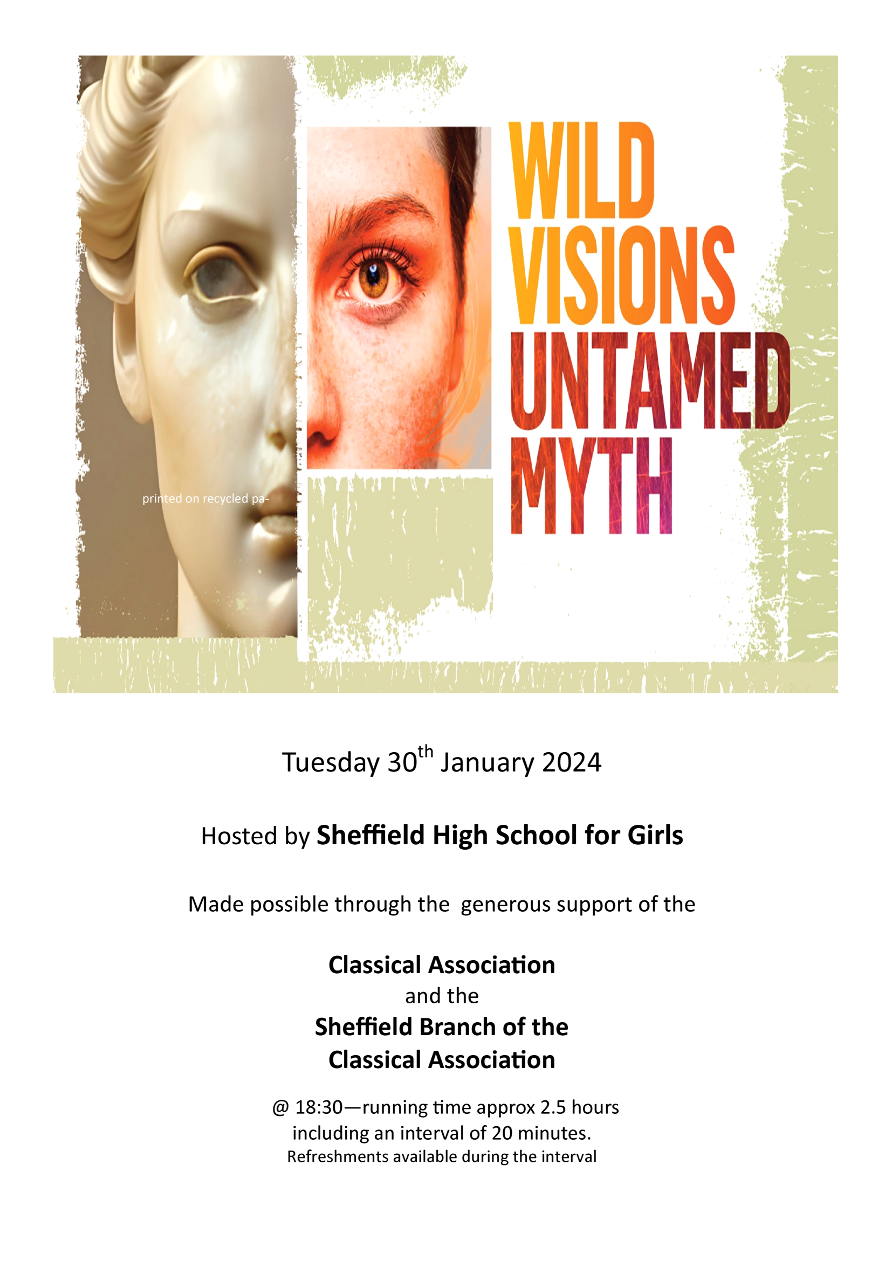
In January, thanks to a grant from the Classical Association and organisation from Sarah Fryer (Sheffield High School for Girls) and Gina Johnson (High Storrs School), the Sheffield and District CA branch held a schools workshop and special public event – a performance of Wild Visions: Untamed Myth by storytellers Katy Cawkwell and Lucy Lill.

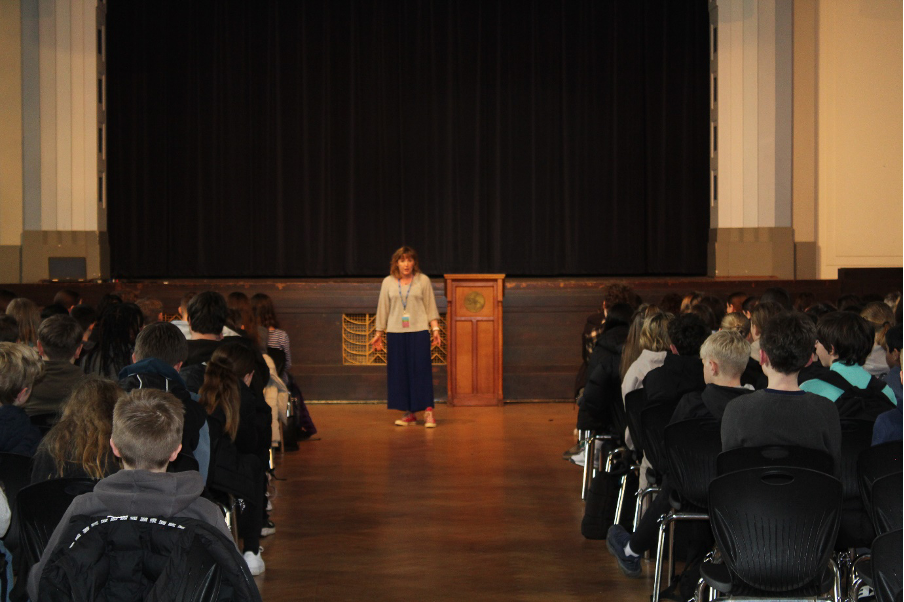
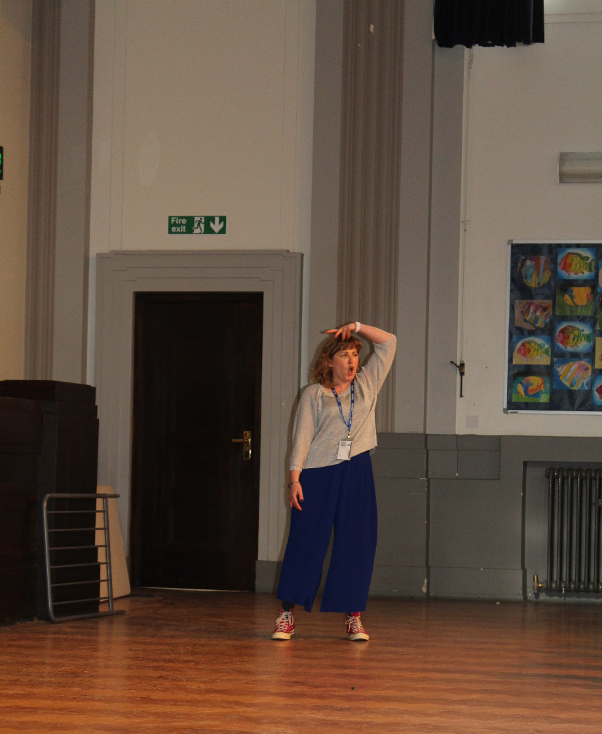
The event appealed to a wide audience and in the opening workshop Lucy told various episodes from the Jason cycle of stories to an entire Year 8 cohort of 240 students, plus a few Year 9s and Year 12s, for almost an hour, holding her audience spellbound throughout with her skill and energy. It was wonderful to see the oral tradition still alive and kicking! There was time for a few questions at the end and there were many hands up, mostly wanting to know what happened next – a sure sign that the students were fully engaged in the process. Applause was loud and long!

The event appealed to a wide audience and in the opening workshop Lucy told various episodes from the Jason cycle of stories to an entire Year 8 cohort of 240 students, plus a few Year 9s and Year 12s, for almost an hour, holding her audience spellbound throughout with her skill and energy. It was wonderful to see the oral tradition still alive and kicking! There was time for a few questions at the end and there were many hands up, mostly wanting to know what happened next – a sure sign that the students were fully engaged in the process. Applause was loud and long!

As Branch President John Drinkwater writes: ‘I can say without hesitation that this was the best-attended, most engaging and most stimulating meeting of the Branch that I have ever attended, and that since 1972! Katy offered her versions of the myths of Leto and the Swan, Artemis, and Procis;  Lucy gave us the sad tale of Cassandra. There was a near-capacity audience of almost 90, comprising people of all ages but, which was particularly encouraging, a large number of teenagers from several schools. Katy and Lucy’s narrations were astonishingly skilful. Time just flew by, and it was clear that all those watching and listening were wholly absorbed by them.’

‘Both before and after the performance, members of the audience keenly received information about the Branch and its activities by registering their email addresses on our website (for the management of which I must also thank our Secretary, Peter Hulse) which bodes well for the future of the Branch and is a justification of its decision to focus on local schools.’

If you would like to find our more or join the Sheffield CA branch, you can contact Peter at this address.

Posted in Event Roundups