As much as we all love Classics, with all its fantastic mythology, literature and art, there is no escaping the fact that it is a subject that is infused with misogyny. It is the common thread that ties together the stories of gods and heroes, who so often use violence against women as a way to prove their strength and power.
Talking about gender equality has become an increasingly difficult topic that teachers are having to tackle head on at the front lines in our classrooms with little guidance or support. We know from platforms like Everyone’s Invited and the investigations of Rape Crisis UK that 90% of school age girls face sexual harassment by their peers which often goes unchallenged. We also know that there has been a concerning rise in misogynistic content which is being pushed towards young men online.
In this context, I have seen how students are shaken and want to try and understand the historical roots of how and why misogyny exists in the world, but don’t know where to start. Both male and female students often don’t feel empowered to talk about these issues amongst their peers for fear of being ‘cancelled’ on social media. For many young people, these issues seem so prevalent and systemic that they are starting to accept it as part of life.
As I teach the three subjects of Classics, History and Politics, I saw an interesting opportunity to lead on showing students how present issues are often the remnants of long shadows from the past. I was keen to find a new way to help kickstart conversations on gender equality in schools, using Classics as a way to stimulate curiosity from students who don’t necessarily study the subject. And so, the Athena Society was born!
Athena Society gives the opportunity for students to explore historical time periods and issues beyond the school curriculum. We can uncover surprising new stories that show women displaying creativity and resistance despite the boundaries imposed upon them, as well as men who have supported and helped change stereotypes. It is a space outside of lessons in a relaxed atmosphere where students set the agenda themselves, deciding on research presentations they want to do, knowing that there is a trusted adult who can guide them through sometimes difficult conversations. Here young people are able to physically listen to each other and to think critically about the media content they consume, through learning new historical information that helps them to understand where modern political issues stem from.
Students who take part in Athena Society feel empowered with knowledge and skills to ask new questions about media content and build a positive ethos across the school environment. By bringing historical context to popular culture, students can get thinking about gender equality and ways they can be actively involved in positive societal change. Changing young minds and helping them to break stereotypes by seeing their unjust historical roots is, in my view, the key to continuing the cause for gender equality. Both young men and young women have to see the importance of this and with student-led projects like Athena Society we must strive to be optimistic for a better future.
Athena Society started as a simple after school conversation in a classroom with a few students after a tragic event, but I hope to build a movement that keeps the question of gender equality alive in schools by researching historical stories and interrogating popular culture. We have grown to include students from across year groups in the school and hosted our inaugural conference in February 2023 inviting local schools to collaborate and listen to guest speakers. We began creating informative Instagram posts @athenasocietyofficial to further our reach and set up a website www.athenasocietyofficial.com including merchandise with our fabulous logo designed by one of our students. We are also engaging with our local MP, taking part in focus groups in Parliament and raising matters of women’s safety in the local area.
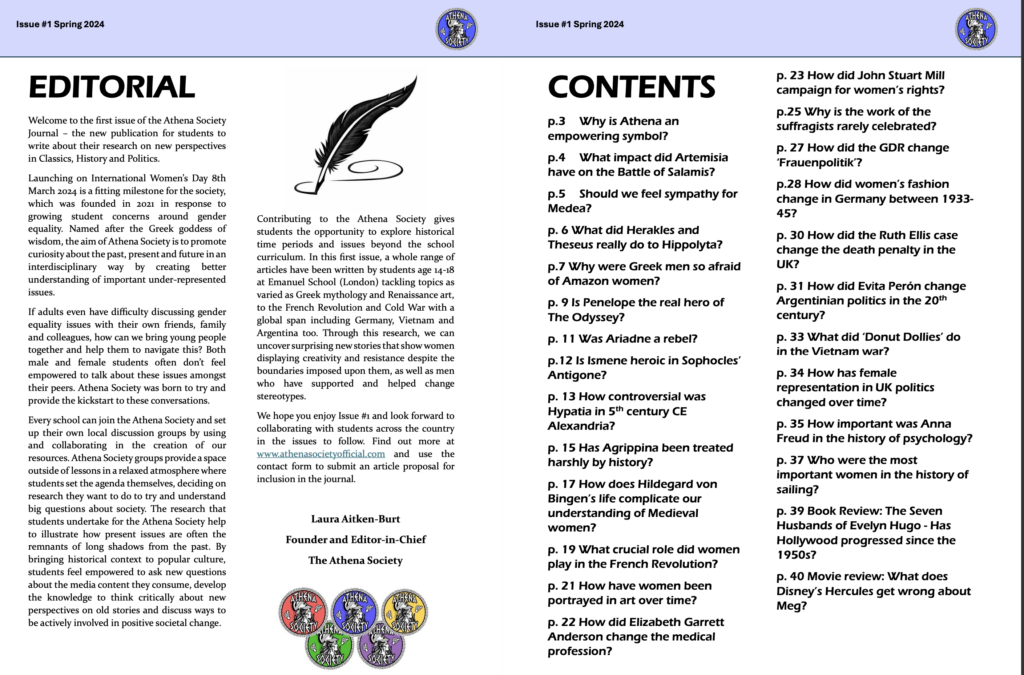
Our latest development has been to create the Athena Society Journal, launched on International Women’s Day 8th March 2024. It contains articles submitted by students on topics they have researched on feminist themes through time. The first issue tackled topics as varied as Greek mythology and Renaissance art, to the French Revolution and Cold War with a global span including Germany, Vietnam and Argentina too.
We hope that this resource will help schools across the country to start their own gender equality conversations, using Classics as an interesting way to bring students into the discussion. To join us, use the contact form at www.athenasocietyofficial.com and encourage your students to send in their ideas for our next issue of the Journal!