Aniket Makhija, a graduate of the University of Rhode Island, shares with us their research into reconstructing Roman dress:
“Textiles can reveal much about the time period in which they are made: social norms, class relations, gender dynamics. Unlike, monuments in stone, however, textiles often fail to survive the passing of time and it can be hard to imagine or recreate the garments that Romans wore. Growing interest in the study of historical textiles and in female economies has helped increase our understanding of ancient fashion and textiles as well as other aspects of ancient culture. I recently undertook a project to explore our understanding of upper-class Roman women’s fashion, by reconstructing it from new and old research in art, antiquity, and textiles and seeing what these reconstructions could reveal.“What did the Romans wear?” produces a much more complex answer than one may think.

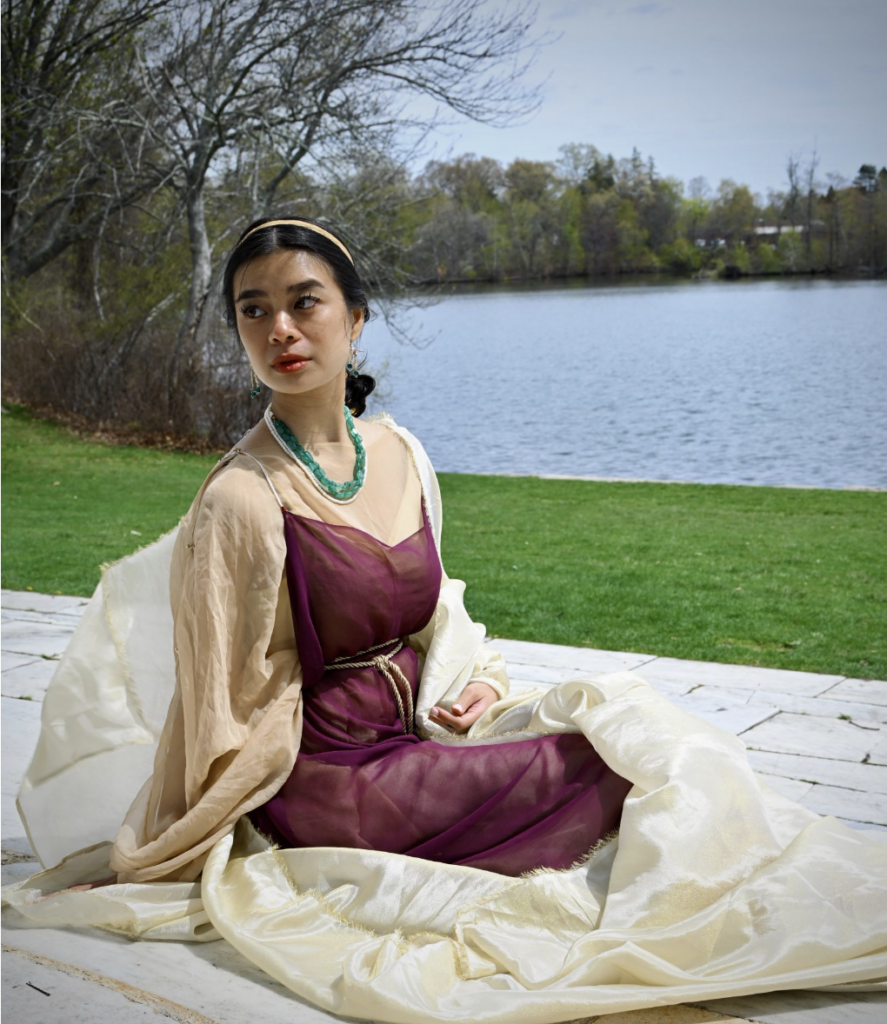
Photograph of Roman costume from the late Kingdom period. Photograph by Angelina Botros. Modelled by Chelsea Taylor.
Roman history is often divided into three eras: the Roman Kingdom (753-509 BCE), the Roman Republic (509 BCE – 30 BCE) and the Roman Empire (30 BCE – 476 CE). Each era brought changes in fashion, with the introduction of new cultural/religious influences, designs, and textile fibers. As such, this project reconstructs upper-class Roman women’s garments across these three time periods and aims to better understand the changing lives of Roman women, who are often overlooked in comparison to their male counterparts, and also help reflect gaps in our understanding in Roman textiles like decoration and the types of stitches used.
It is important to note that reconstructing dress from antiquity provides many challenges. Not many textiles survive from these time periods and those that do survive tend to be fragments of the original garment: often poorly studied, or lacking indications of their construction techniques. Furthermore, for the scale of this project, I chose fabrics with similar weaves and fiber content, instead of handweaving other examples. Despite these limitations, this project still reflects the styles, textiles, fibers, and construction techniques available to Romans and highlights areas for further research.
1. Late Kingdom – Early Republic (550-500 BCE)
Information about the Romans from this time period comes from later authors, many of whom trace the origins of some customs, including dress customs, to the Etruscans. There is some debate between scholars about whether early Roman women wore the toga. However, surviving Etruscan art shows not only show similar garments worn by later Romans, but also show Etruscan women—and possibly Roman women—wearing the tebenna, the Etruscan precursor to the Roman toga. The Etruscan statue below shows a woman with a draped stole. The folds of the stole drape to a corner laterally to each side of the body with a circular shape on the back—all signs that the stole depicted is a tebenna.
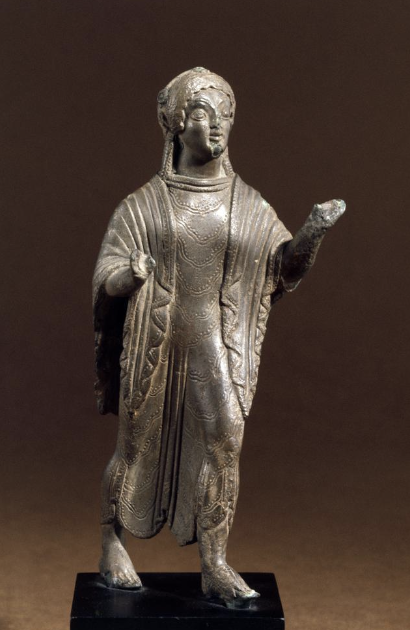
The Votive Figure/The British Museum/
Creative Commons Attribution-Share Alike 4.0
The tebenna in figure two was based on two different tebennae found in the Villanovan era Etruscan tomb, Tomba del Trono. Both garments were made of a twill woven wool with tablet woven edges. This was replicated with a twill woven blue wool cut into a semicircular shape with similar dimensions to the extants and a similar tablet woven trim with patterns. As for the sewing style and thread type, the extants were woven into shape with the tablet woven edge directly woven onto it. This was not feasible to do due to time constraints, so the raw edges of the tebenna were folded over and covered with the trim hand stitched on the edge using both running and felling stitches in linen. Both these construction techniques and linen thread were not only widely available in Iron Age Europe but were also found on other textiles in the tomb, making them a good fit for this reconstruction.
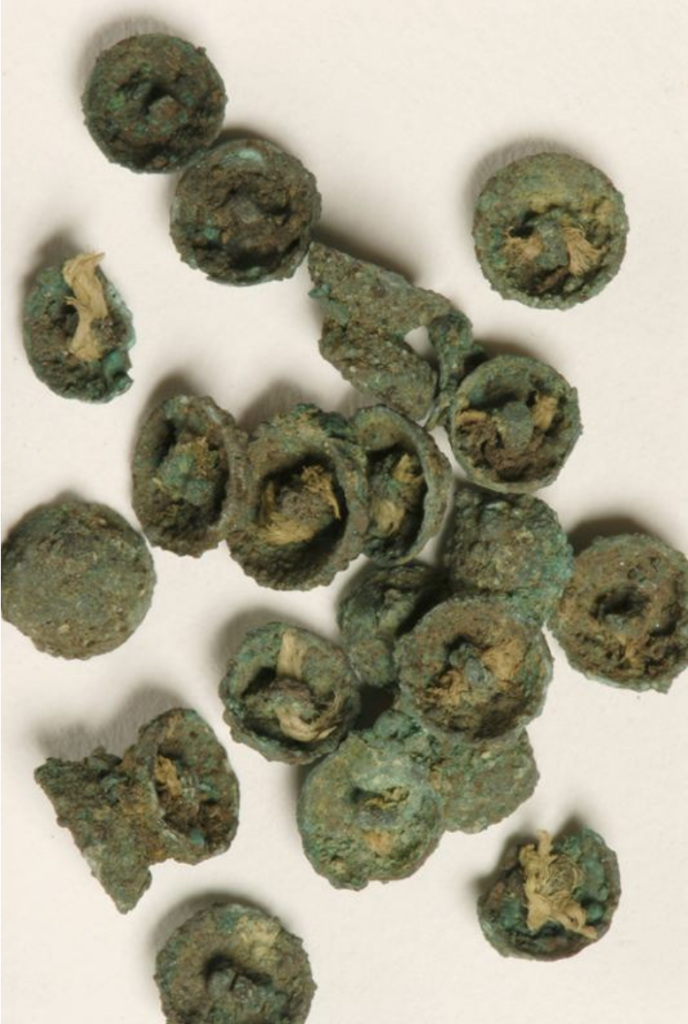
The ionic chiton, a long full sleeve garment popular in both Greece and the Italian peninsula at this time, was constructed out of a plain weave linen fabric, similar to the extant linens found in the tomb. The tunic was created from a front and back piece. The side seams were run stitched together then folded and felled down with linen thread. A gap was left in each seam a couple inches from the top to make room for arm holes. Excavations throughout the Mediterranean reveal a variety of bronze and gold shank buttons, like those in figure four. Thus, I chose to sew 8 ½ inch bronze buttons on the top of the tunic. A parallel thread loop was made for each button. While there is evidence of garments being connected with button loops, there is no strong evidence of them being specifically thread loops.
2. Late Republic to early Empire (100 BCE – 50CE)
The stola, a long garment with a V neckline, first appears in art from the third century BCE, possibly of Etruscan origin. This garment was worn by married Roman women up until the early Roman Empire, signalling their status as a matrona. The stola was worn over a tunic (usually an ionic chiton) and palla, a rectangular stole. Around the 1st century BCE, silk textiles were introduced to the Romans and became widely popular fiber among the upper class. Fine silk textiles are depicted in frescoes like in figure six. Authors like Seneca give us further evidence for the prevalence of silk: he denounced women and matrons who wore these sheer fabric for being immodest. Since there are no stolas or thin silk textiles that survive from this time, most of the evidence for the reconstruction was based on statuary, art, and descriptions.
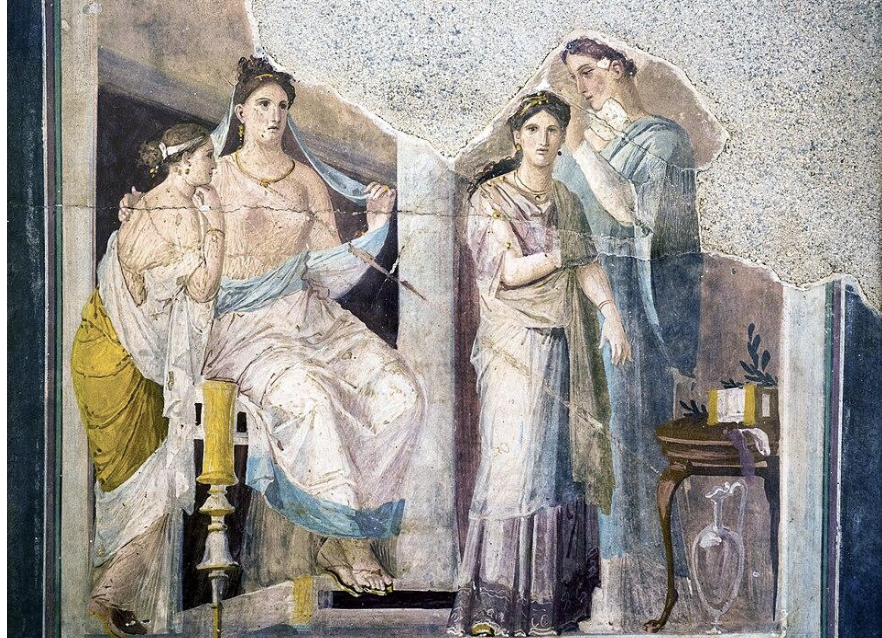
Creative Commons Attribution-Share Alike 4.0/Credit: ArchaiOptix
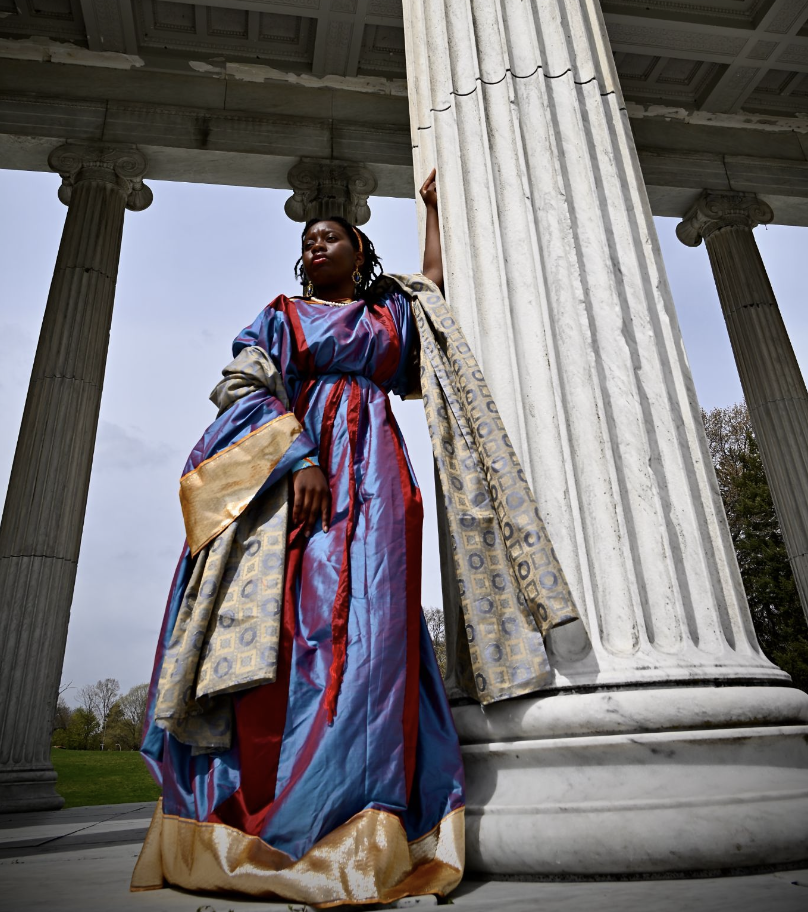
To match the sheer qualities of the fabrics used in stolas and the ionic chiton, I used silk chiffon, a plain woven fabric with alternating twist threads in the warp. While there is evidence of alternating twist threads in the warp, pure silk fabrics were not common during the early Empire and were often woven with other fibers. The fabric was draped on the body, mimicking the neckline and the strap positions seen on stolas depicted in art. The raw edges on both the tunic and the stola were rolled and whipped together to finish the seam. While there is no evidence of this technique, it was necessary in order to prevent the textiles from fraying. The insitita is a 6-8cm wide decorative border either sewn or woven onto the hem of the stola. A gold trim with a diamond pattern similar to some extant silks was sewn onto the hem. Afterwards, straps and buttons were added to the stola and ionic chiton. Archaeological finds from Ostia provide insight to what the vitta, the band worn on the head of a matrona, and belts looked like. The finds show us vittae made of ribbons and a belt made from a double twisted cord, both of pure gold. Metallic ribbons and a gold coloured cord were used to mimic these accessories.
3. Late Roman Empire (350 CE)
Around the third century CE, the dalmatic tunic, a wide sleeve tunic of West Asian origin, came into fashion. These were often richly decorated with complex clavii (two vertical stripes on the tunic) and borders. Evidence shows these were made of a wide variety of textiles. By the fourth century, it was fashionable to have a tighter under tunic whose sleeves peeped out of the outer dalmatic. The reconstructed dalmatic was based on a Musician mosaic fresco from the fourth century. The body of the tunic was made out of plain woven silk which was cut into the dalmatic shape. Different metallic and silk trims were used to create the borders and clavii on the dalmatic. I used running or whipped stitches to hold them in place, similar to those on extants. While these would have been woven onto the fabric base itself, there is evidence of clavii being stitched onto the tunic body. The side seams were stitched together with a running stitch, and the head hole was reinforced with trim, construction techniques found on similar garments.
Conclusion
The purpose of this project was to experimentally reconstruct Roman women’s dress from various time periods. The garments I created reflect just some of the vast body of information that we have on Roman textiles, but they also open up gaps in our understanding. Some questions that came up frequently in this project pertained to stitch length and techniques. Additionally, the project highlighted the lack of distinction in types of decorations used in each specific time period. Further research should be done in these areas to help gain a better understanding of how these pieces would have been made. That said, reconstructing these garments already increases our understanding of how Roman women dressed, looked, and moved in these garments—insights that the field of textiles is uniquely suited to provide—and breathes life into an historically overlooked group.”
Recommended Reading
Bonfante, Larissa. Etruscan dress Baltimore, Maryland: Johns Hopkins University Press, 2003.
Seneca, De Beneficiis, 7.9.5
Croom, Alexandra. Roman clothing and fashion Stroud, Gloucestershire: Amberley Publishing, 2010.
Elderkin, Kate McK. “Buttons and Their Use on Greek Garments.” American Journal of Archaeology 32, no. 3 (July 1, 1928): 333–45. https://doi.org/10.2307/497471.
Forsythe, Gary. A critical history of early Rome: From prehistory to the first punic war Berkeley, California: University of California Press, 2006.
Gleba, Margarita, and Ulla Mannering. Textiles and textile production in Europe from prehistory to AD 400. Oxford: Oxbow Books, 2021.
Marcellinus, Res gestae, 22.5
Hart, Mary Louise, Monica Ganio, Susan Lansing Maish, Douglas MacLennan, and Karen Trentelman. “ Vittae Auratae: Interpreting the History and Technology of a Group of Roman Gold Textile Fragments.” Getty Research Journal 14 (August 1, 2021): 1–20
Morgan, Faith Pennick. Dress and personal appearance in late antiquity: The clothing of the middle and lower classes Leiden, South Holland: Brill, 2018.
Mossakowska-Gaubert, Maria. “Tunics Worn in Egypt in Roman and Byzantine Times: The Greek Vocabulary.” Zea Books , July 26, 2017. https://doi.org/10.13014/k2xd0zvc.
Radicke, Jan. Roman women’ s dress: Literary sources, terminology, and historical development Berlin: De Gruyter, 2023.