News & Articles
OUR COMMUNITY
Lorem ipsum dolor sit amet, consectetur adipiscing elit, sed do eiusmod tempor incididunt ut labore et dolore magna aliqua. Ut enim ad minim veniam, quis nostrud exercitation ullamco lori.

CA Conference 2025 – Call for Contributions (August 2024)
Held in partnership with the CA and the Classical Association of Scotland, the School of Classics, University of St Andrews will host the 2025 Conference in the heart of historic St Andrews, in Fife. University accommodation will be available for booking. More detailed information about practical issues will be distributed when the programme is finalised in January 2025. There will be two plenary lectures, one on Friday evening, and the other on Saturday evening by the new CA President for 2024-25, Professor Stephen Halliwell. You can also look forward to receptions, the Conference Dinner, a Ceilidh, prizegivings, opportunities to visit the Cathedral and Castle sites in St Andrews, and much more!

We welcome everyone to attend or contribute to the Conference. General registration will open in the New Year, but if you would like to propose a contribution please read the information here and submit your proposal by 30 November.
Education News (June 2024)
Classical Languages CPD Day
We’re hosting a free online CPD day for Classical Languages on Tuesday 2nd July. With practical sessions such as modelling & scaffolding, and vocabulary acquisition, this event is suitable for teachers from KS3-5. Find out more and register here.
We have recently published the translations for the GCSE Classical Greek set texts for examination in 2025 & 2026. You can find these via this page.
Our Qualifications Review continues this term, with the release of our second survey, focused on GCSE and A Level Ancient History. We would love to hear from as many practitioners as possible, so please circulate this to your colleagues. You can find more information about our Qualifications Review on this page. The deadline for completing this survey is Monday 9th September 2024.
NEC Bursaries for Teachers applications open (May 2024)
We are delighted to once again be offering five full bursaries for state sector teachers to begin studying an A Level in Classical Civilisation with the National Extension College. At a time when teachers are busier than ever, the NEC course offers the flexibility to fit your learning around your lifestyle and to study at your own pace. You can find more information on the NEC website. Apply online now!
Claire Woozley, Regional Lead Practitioner for English at Ormiston Academies Trust, has written about her experiences of undertaking the A Level with the help of a CA bursary, and how it has helped reignite her love of learning.
You can also watch testimonies here from Claire and some of our previous recipients:
Call for expressions of interest in the position of Honorary Treasurer position (April 2024)
We are looking for new trustees to join our organisation as our activities expand and we continue to develop our role as the Subject Association for Classics in schools, and seek to increase our membership. We wish to appoint an Hon. Treasurer to provide leadership and advice to the charity on financial matters and to help the trustees fulfil their responsibilities for the financial governance and direction of the organisation.
Applicants should
- have substantial financial and management experience;
- have a keen interest in supporting the classics;
- be willing to act as a charity trustee, unremunerated.
If you would like to know more, please email Clare Roberts on classicalreview@classicalassociation.org for an information pack.
Classics and Class Survey (February 2024)
The UK Class in Classics Report (2024), part funded by the Classical Association, is available to read here. It is based on the UK Class in Classics Survey which ran from late 2022 to early 2023. This had a total of 1,206 respondents and revealed class disparities across student and staff bodies. The report reveals that class disparities heighten along the academic career path, showing a leaky pipeline in which working-class classicists are squeezed out of the discipline. The report suggests that class intersects with other axes of inequality – ethnicity, gender identity, sexual orientation, disability – and indeed compounds them.
The UK Class in Classics Report 2024 is likely to be the first report of its kind produced in UK Higher Education and one of the first to examine the intersections between class and other characteristics in an educational context. The report urges a radical rethink of EDI practices in order to embed class alongside other axes of inequality and offers a series of recommendations for schools, universities, and policy makers to give serious consideration to, and implement wherever possible.
The CA’s Qualifications Review (January 2024)
Our Qualifications Review is now well underway, with the first of our surveys now open. As the teaching community readies itself for the next round of exam reform, our Teaching Board and Subject Advisory Teams are working hard to review the current specifications, prioritise areas for redevelopment and develop proposals we hope will ensure our subjects remain engaging and relevant.
Our first survey is asking for feedback on the current GCSE and A Level classical languages specifications. You can take part here: https://forms.gle/Gvsycjj1LwwZVgeb7
You can find out more about our Qualifications Review, and who is involved in our Subject Teams over on this page.
Our Education Co-ordinator, and our Subject Team Leads will be running focus groups as part of this review process at a number of events this year, including the Harrow School’s Ancient History Teachers’ Day, ARLT Refresher Day and at the CA Conference. We will also be holding online focus groups for those who would like to discuss our proposals in more detail.
Classics and Careers – A New Podcast Series (August 2023)
The CA is delighted to launch a brand new series of The Classics Podcast – Classics and Careers – which explores how a range of interesting people have built their careers around, or been influenced by, the ancient world. Our mission is to create entertaining, positive and inspiring content for a diverse audience and this season features guests from all walks of life, from anthropologists to actuaries, producers to policy advisers, who have a connection to classics and lead fascinating lives.
Podcast host, Katrina Kelly, and each guest discuss what classicists bring to the workplace (and the world!), the resonance of the #ancientworld, how to forge your own path, and where studying the past can take you.
Follow The Classics Podcast on Podcasters, Spotify, Apple Podcasts and Instagram to make sure you don’t miss out on a single episode!
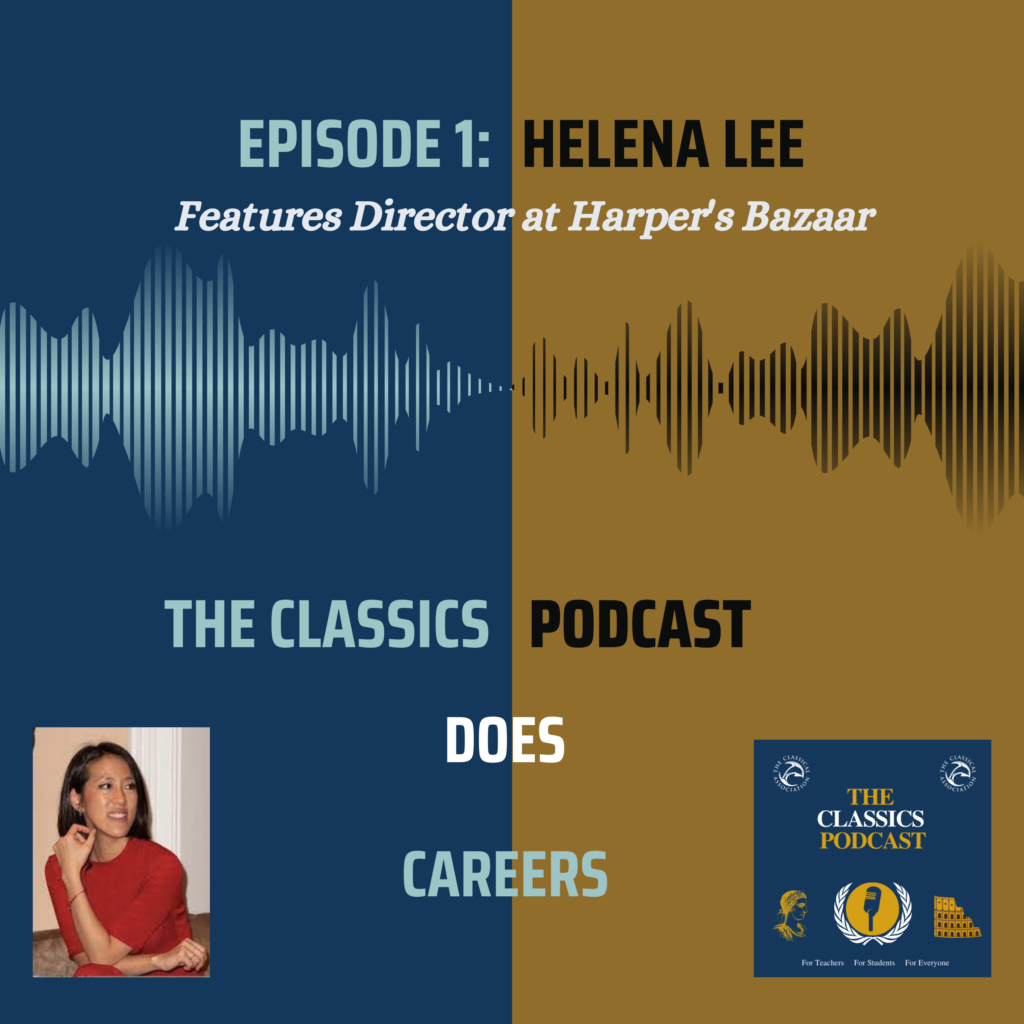
Episode 1 features Helena Lee, Features Director at monthly fashion magazine Harper’s Bazaar, who discusses learning how to develop and defend an argument, becoming a writer and an advocate, and who would be the cover star of an ancient edition of Harper’s Bazaar!
Ancient Languages in Primary Schools – new report (November 2022)
We are pleased to see the publication of a new report by Board members and University of Oxford researchers, Dr Arlene Holmes-Henderson and Katrina Kelly, who have been working in partnership with the Department for Education to research the provision of Latin and Ancient Greek in primary schools in England. This is the first government-commissioned report in ancient languages for 34 years.
The report, alongside ongoing research by Dr Holmes-Henderson, suggests that learning ancient languages has a variety of positive effects on primary pupils’ attainment, especially their literacy levels, and particularly in those with Special Educational Needs and Disability (SEND), those who have English as an Additional Language (EAL) and those who qualify for the Pupil Premium.
According to the report, barriers to teaching languages in primary schools include timetabling pressures, a lack of confidence amongst teachers, and the prioritisation of Maths and English provision. A further barrier, as Dr Holmes-Henderson added, is: “the lack of reliable data about the study of Latin and Greek in the primary sector. This report makes clear that if Latin and Greek are to be taught more extensively in primary schools, there needs to be a co-ordinated national programme of teacher training”.
The report finds that while Latin and Ancient Greek have been included as options in the primary school languages curriculum since 2014, the policy ambition of widespread learning of ancient languages in primary schools requires significant further investment. The Classical Association is proud to support teachers and pupils with additional resources and professional development, to encourage pedagogical knowledge exchange and research, and to fund educational projects and outreach events – to apply for a CA grant click here. Our annual Competition, with more £1000 prize money to be won, is also open to primary school pupils.
________________________________________________________________________________________________________
2022 Examinations Letters
Following the summer 2022 exam series, we were contacted by a number of schools raising their concerns over the GCSE Classical Civilisation papers. As the Subject Association for Classics, we have represented these views in a letter to OCR, to which they have replied. You can read these letters here:
Response to the Publication of Advance Notices
The CATB welcomes the release by examination boards of Advance Information for GCSE and A-Level classical subjects due for examination in 2022.
In December 2021, the Department for Education mandated that the purpose of this Advance Information was “to provide appropriate guidance to teachers and students to focus revision”. As a result, OCR and Eduqas both published their Advance Information notices on 7 February 2022.
OCR has since published a number of blogs, made available via mailing lists and social media, answering key questions for each of the subject areas, which can be found here. Additionally, OCR ran three subject webinars which offered teachers the opportunity to direct their queries to Alex Orgee, Subject Advisor for Classics. These were very well attended by the teaching community.
Eduqas has also sought to support their centres through the creation of sample knowledge organisers for each of the components for their GCSE Latin qualification, which can be found here.
The CA Teaching Board has relayed feedback shared by teachers regarding the Advance Information notices to the examination boards, to which both OCR and Eduqas have responded. We recognise that other approaches, for example a reduction in subject content, may have provided greater support for students whose learning has been so affected by the pandemic, but we acknowledge that this was not the Department for Education’s intention. From discussion with both of these examination boards, we believe they have done all that they can within the policy remit to assist teachers and students with the 2022 summer exam series. We will continue to work collaboratively with them, as well as with the teaching community, to ensure the concerns of teachers are central to their considerations for future exam series.
________________________________________________________________________________________________________
Joint statement on DfE announcement (July 2021)
The CA has recently joined forces with the University Council of Modern Languages to write a statement relating to the recent DfE announcement of support for new and existing initiatives to develop in England the teaching of languages, cultures and societies, both modern and ancient, which includes funding for a new Latin Excellence Programme. You can read the statement here.
Euroclassica
Euroclassica is the European non-profit association of teachers of classical languages and civilisations. Find out more here.
You can follow Euroclassica on Twitter at @Euroclassica, and read the latest newsletter here.
The 2021 Euroclassica Conference and General Assembly will take place in Split, Croatia and Mostar, Bosnia-Herzegovina from 27-29 August. Further information and a provisional programme are available here, and registration details can be found here.
How to Present at a CA Conference
On Monday 14th June 2021, the CA hosted a virtual event for schoolteachers, designed to provide information, and dispel myths, about presenting at a CA conference as a teacher. Devised and hosted by the CA’s Outreach Officer, a former schoolteacher herself, the event was a successful example of collaboration and knowledge exchange across educational phases, with both academics and teachers presenting.
The organisers of the CA conference in Swansea 2022, Ian Goh and Maria Oikonomou gave a short presentation explaining the difference between a paper and a panel, outlining what makes a successful abstract and charting the process from abstract submission to conference presentation.
Three teachers then provided personal testimonies of their CA conference presentation (and attendance) experiences. Pete Wright (Blackpool Sixth), Gemma Williams (Allerton Grange School, Leeds) and Andrew Christie (Streatham and Clapham High School) explained which CA conference they had attended, what their paper title had been, how many people had been in the audience, whether they applied as a paper or as part of a panel, how they handled questions and whether the conference had been as expected.
In a Question and Answer session, Pete, Gemma and Andrew then answered questions such as:
- What approach did each of you take to your ‘presenting style’? Did you read from a prepared script, talk through powerpoint slides or something else?
- How did you handle questions from the audience?
- Tell us about your liaison with the panel chair.
- Did you produce a handout?
- How long did your presentation last?
- Did you get time off from your school to attend the conference?
- Did you pay to attend the conference, or was there some support available?
Pete, Gemma and Andrew ended by sharing their top three tips for aspiring teacher presenters. These included suggestions such as, ‘Go for it! You present information in an engaging way every day, why would 20 minutes at the CA be any different?’ and ‘Don’t try to cover too much – the time goes really quickly’.
Ian and Maria ended the event by promoting Swansea’s tourist attractions – the conference is about more than just the academic papers – and making it clear that abstract submissions from teachers are especially welcome, with one whole theme dedicated to Pedagogy, Outreach and Technology. Other possible themes include Classics and the Future and Digital Classics.
Full details can be found on the Conference page of the website.
Because this event was the first of its kind, we were keen to gather feedback from participants. Results showed that 100% of attendees found the event ‘extremely useful’. 100% of attendees felt better informed about writing an abstract. 100% of attendees felt better informed about the difference between a panel and a paper. 100% of attendees said it was ‘likely’ that they would submit an abstract to the Swansea conference. When asked what they found most surprising, comments included: ‘how many people attend the CA conference’ and ‘that academics are keen for schoolteachers like us to get involved and have our say’.
Watch all of the recorded sections here:
Dr Arlene Holmes-Henderson, CA Outreach Officer
Open Letter to the DfE on ITT bursaries
In November 2020 Dr Sharon Marshall, Chair of the CATB, wrote an open letter to the DfE challenging cuts to Initial Teaching Training bursaries which were announced on 13 October. Read the letter.
.