This is a longer version of an article published by Cambridge University Press, which you can read here. Professor Greta Hawes, Joint Commissioning Editor of The Classical Review and Katrina Kelly, Engagement Director at The Classical Association, share how newcomers can access the epic beyond the cinema and explore the wider world of Homer’s poems.
Films like Nolan’s The Odyssey tend to spike public interest in the reference material for a few weeks, what would you want a first-time reader, arriving via the cinema, to read next or if not read, would you recommend other routes to the classics via games, podcasts etc.?
GH: the best thing to do is dive into Homer’s version! Emily Wilson’s recent translation really captures the humanity and the fun of this epic. Even better is to get it on audiobook. Homer’s epics were performed to audiences, so listening to it rather than reading it gives you a much better sense of that experience. The whole thing is very long; in antiquity they divided it into 24 scrolls, which we now call ‘books’. You can read (or listen to!) just bits at a time. The most fun parts are about Odysseus’ adventures with gods and monsters. These are books 5 to 13. Book 9, when he meets the Cyclops, is particularly gory.
If you want to find out more about Greek myth, there are a lot of good podcasts around. I recommend this one by Scott Smith and the students of the University of New Hampshire, or the CA’s very own Classics Podcast series on Virgil’s Aeneid if you’re interested in Roman epic (and the poem where Sinon actually appears, since he doesn’t feature in either The Iliad or The Odyssey).
What do you find usually puts people off Classics? What would you say to someone who assumes classics are inaccessible or ‘not for them’?
KK: confusing divine family trees (how can Zeus and Hera be brother and sister, and man and wife?!), unusual names like Neoptolemus and Persephone and a sense of fear about how to pronounce them (it’s ‘Purr-seff-o-knee’ not ‘Percy-phone’ for example, but really we don’t care how you pronounce them!), and the length of Homer’s epic poems – over 12,000 and 15,000 lines of verse in the Odyssey and the Iliad respectively – can all be daunting to new readers. But by accepting that these stories are as tantalisingly familiar as they are fascinatingly alien to us, we can embrace the wonders of this mythological world.
The conventional division of the poems into 24 chapters (‘books’) helps break them down into manageable chunks for the reader and the ancient storyteller alike. Many of these books include multiple shorter episodes or are combined to form a wider narrative arc. In books 9-12 (the apologoi), Odysseus recounts recent events to form a carefully-woven (and perhaps wildly exaggerated, such is the ‘wily’ hero’s way with words) Odyssey within the Odyssey; an inheritance of a poetic canon of ‘adventure stories’. The Odyssey has been so popular throughout history because it has, at its core, an engaging revenge drama and a divine-driven journey, featuring complex characters with contrasting desires whom we root for (Odysseus, Circe, Telemachus, Penelope) – will the hero make it back to Ithaca, against Poseidon’s will, with any of his crew remaining?
Even if we may not have battled in Troy for ten years and been buffeted at sea for another ten, we can all relate to the poem’s timeless themes. We can understand feelings of ’nostalgia’ (the ‘pain’ of ‘homecoming’) and the difficulty of reintegrating with our family after a time away; of striving for something whilst worrying about the reality of reaching it, or of missing our target; of using words persuasively to try and get ourselves out of a hole (albeit, maybe not a Cyclops-shaped one) and worrying about your team losing faith around you; of missing a parent or partner, of falling in love with someone who is destined to leave you, of being or having an absent father, of trying to figure out your place in the world as a young adult, of being blamed for the failings of others, of deciding whether to remain in the past or move on with your life.
Classics casts a light on age-old problems and once you’ve accessed them – by reading or listening to these stories, watching a play or a movie, visiting an ancient site – they help you dig deeper into your own emotions and experiences.
Are there specific conventions or Homeric habits (epithets, in media res structure, invocations of the muse) that trips up first-time readers, how would you guide someone through unfamiliar story structures compared to contemporary fiction?
GH: the thing that confused me most when I first read Homer was the huge number of minor characters that appear. He expects that his audience will recognise a lot of these names because they are familiar with the Greek myths. I suspect that he’s also catering to audiences across Greece who all want to hear their own local heroes mentioned. Of course now a lot of these references just go over our heads. Many characters are just mentioned once and never appear again, so it’s not necessary to try to memorise all of them. I think that Homer does this because he wants to give the impression that his stories are happening inside a huge story-world that’s much larger than just the stories that he can narrate. So, while he’s following Odysseus’ journey he wants you to be aware that there are thousands of other stories playing out that he can’t record. He’s essentially only giving us glimpses of them as they intersect with Odysseus’ life. If you think of a book or movie or TV series set in its own universe, like Lord of the Rings or Game of Thrones, you get the idea of what he’s doing with all these thousand minor characters with fleeting roles.
Can you recall when something clicked for you when you started enjoying reading classics?
KK: it was an exciting moment to realise how some characters that appear in one ancient text, reappear in another, such is the connectivity of ancient mythology. The Odyssey opens with a council meeting of the gods where Homer describes Zeus as briefly remarking how the Greek king Agamemnon has been slain by his wife’s lover, Aegisthus, whom the king’s son Orestes has consequently murdered in revenge, after he ignored Hermes’ advice. It’s only a short reference but these events are recounted in much more detail in Aeschylus’ Oresteia, as well as other versions of the myth by Euripides and Sophocles, all of which show how once you jump into classical literature, you may find yourself lost forever in a fascinating world, constantly mindblower by the cast crossover, just like when a doctor from Casualty used to pop over to a ward to help a patient in the next episode of Holby City.
What’s a scholarly debate about the epic poem that non-specialists would find genuinely fun, not just technical?
GH: my favourite debates are about which parts of the Odyssey are set in known places, and which are set in fictional ones. There are still ingenious attempts to ‘map’ where Odysseus travelled. Obviously, he leaves from Troy (which the Greeks thought was on the Dardanelles, in what is now Türkiye), and goes home to Ithaca, which is an island off the western coast of the Greek mainland. I personally think that, when Odysseus gets caught in a storm, Homer wants us to think that he’s no longer in the ‘real world’ of the Mediterranean. That’s why there are so many more fabulous things in that part of the voyage — giants and goddesses and monsters and even an entrance to the Underworld. It’s like he’s gone through a portal into ’the Beyond’, and only gets out of it when the Phaiacians finally take him back to Ithaca while (conveniently!) he’s asleep.
Lots of ancient geographers tried to identify the places that Odysseus had gone, too. And they often provided ‘proof’ of their claims. For example, Pliny the Elder records that three small islands off the coast of Sicily were the rocks that the Cyclops threw at Odysseus as he escaped, so he must have lived on Sicily. Artemidoros said that the lotos-eater were nomads in north-west Africa, what moist roots to quench their thirst in the desert. And people said Circe must have lived on the coast just south of Rome because a lot of medicinal herbs grew there. Circe changed men into animals and kept them under her power. Some said that she had passed this power down to her descendants, the Marsii, who were a group of Italians famous as snake-charmers. There were even reports that Odysseus had left offerings in sanctuaries in Spain and Italy, and they still survived.
To read more scholarly takes on The Odyssey, enjoy our blog feat. exclusive content from our Omnibus magazine.
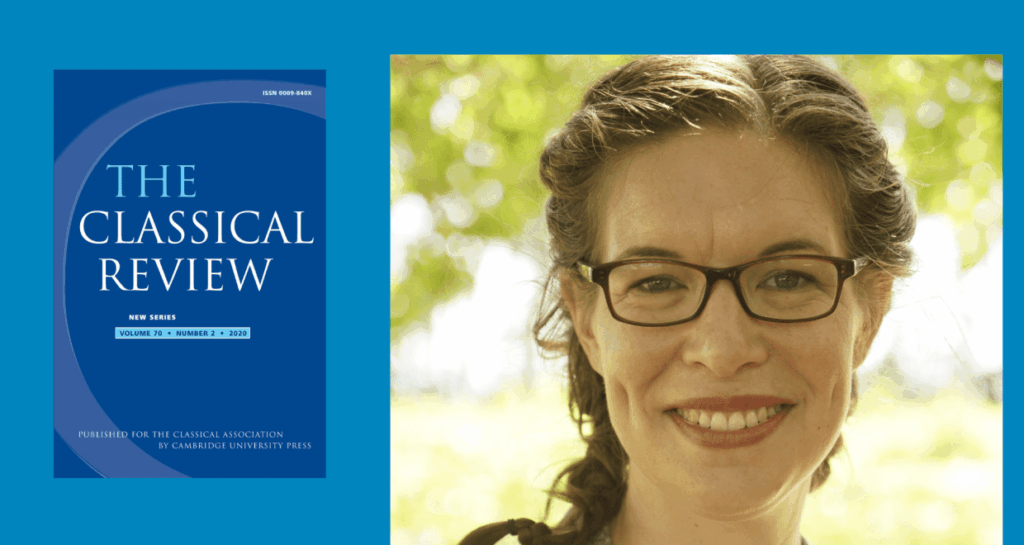
Prof. Hawes is the Joint Commissioning Editor of Classical Review, which you can access here!