The Odyssey, a little at a time: Greek and English, passage by passage
Alex Michalas of GreekMythology.com describes how his team built a free library of ancient sources, with the original and a translation side by side, and suggests a few ways to use it in the classroom.
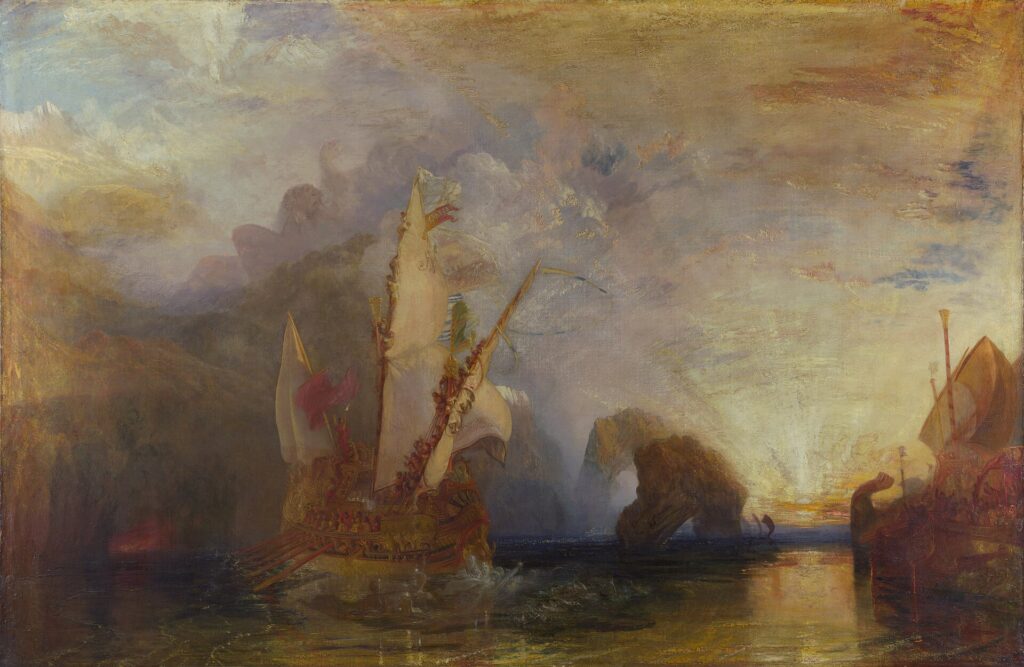
Public domain, via Wikimedia Commons: https://commons.wikimedia.org/wiki/File:Turner_-_Ulysses_deriding_Polyphemus_1829.jpg
Some 12,000 lines of hexameter is a great deal to ask of a first-time reader. When Greta Hawes and Katrina Kelly considered on this blog what to do when Homer feels daunting, Professor Hawes offered the simplest of remedies. The poem was divided in antiquity into 24 scrolls, the “books” we know today, and “You can read (or listen to!) just bits at a time.” Her suggested starting point was Odysseus’ adventures with gods and monsters in Books 5 to 13, with Book 9, the Cyclops, “particularly gory”.
Reading Homer in small, manageable pieces is the idea behind the Ancient Sources section of GreekMythology.com, which has been online as a free guide to the Greek myths since 1998. The section (greekmythology.com/sources) gathers the texts the myths come from, each in its original language with an English translation beside it, divided into short passages you can cite, link to and read on a phone. Katrina kindly invited us to explain how we put it together and how it might be useful to teachers.
Why short passages, side by side?
A complete Odyssey, whether in a printed edition or on one long web page, asks a newcomer to commit to the whole voyage at once. A single scene is a far smaller ask: Hermes sent to Calypso, the building of the raft, the storm. So we divided the poem into 121 passages of roughly 80 to 200 lines each, following the natural scenes rather than a fixed line count. Each has a plain title (“Odysseus builds the raft”; “The wine and the name Noman”) and opens with a few sentences of our own on what happens and who is in it, so that readers know where they are before the hexameters begin.
Setting the original beside the translation serves several kinds of reader at once. A reader with no Greek or Latin can switch to the English alone. A student in the first year or two of a language can read the English and glance across to the original, or the other way round; within each passage the two are aligned in blocks of twenty or thirty lines, so they never drift far apart. A more confident reader can switch to the Greek or Latin alone and keep the English out of sight until it is needed.
Every passage also has its own address. Odysseus’ trick with the wine lives at greekmythology.com/sources/homer/odyssey/9-345-394, a link that can go straight into a worksheet, a homework email or a slide. Within a passage, clicking a line number copies a link to that line, so you can send a class straight to 9.366, where Odysseus gives his name as Οὖτις, “Noman”. A “Cite this passage” button gives the reference in MLA, APA and Chicago styles, putting the ancient author and line reference first, and then the translation used.
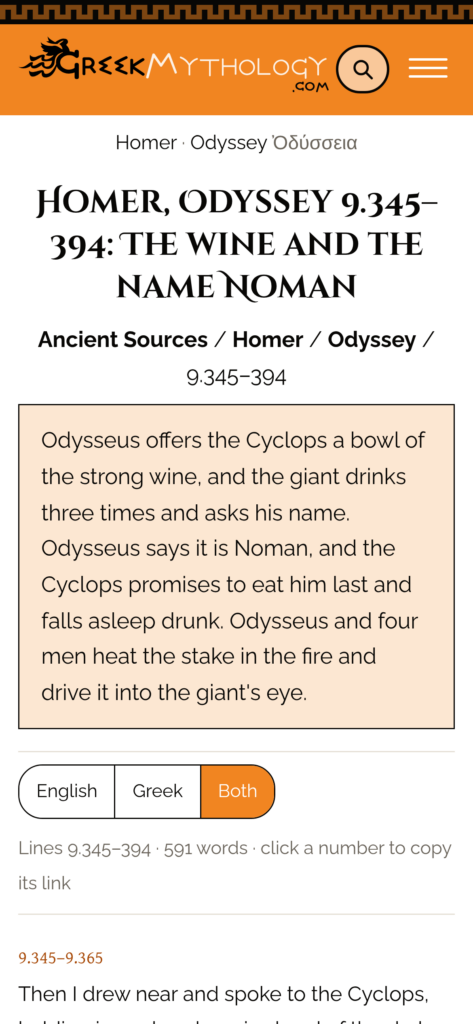
Odyssey 9.345–394, “The wine and the name Noman”, on a phone: a short summary, then the passage itself, with buttons to show the English, the Greek or both. Clicking a line number copies a link to that line. Screenshot: GreekMythology.com
How we put it together
The first decision was about translations. We wanted everything to be free to read and free to share, with no login or paywall, so we chose translations that are out of copyright. For Homer that means A. T. Murray’s (Odyssey 1919, Iliad 1924); for Hesiod, Hugh G. Evelyn-White (1914); for Apollodorus, Sir James George Frazer (1921); for the Aeneid, Theodore C. Williams (1910); and for Ovid’s Metamorphoses, Brookes More (1922). Many of the Greek and Latin texts come from the openly licensed (CC BY-SA 4.0) editions that the Perseus Digital Library at Tufts University publishes on GitHub; others come from scans of pre-1930 editions. The translations themselves are in the public domain. Every passage names its translator and edition at the foot of the page.
Because these translations are around a century old, the English is often of its period: Murray’s Odysseus addresses the Cyclops as “thou”. But Murray stays close to the Greek, and for a student reading the two side by side that literalness can be a virtue. For reading purely for pleasure, a modern version such as Emily Wilson’s, which Professor Hawes recommends, will be livelier, and the two work well together.
For a few lesser-read texts, where we had no suitable public-domain English to hand, we have made new translations of our own from public-domain editions. Hyginus’ Fabulae, for example, is translated from Moritz Schmidt’s 1872 text, which we transcribed and corrected against a scan held by the Internet Archive. These new translations were drafted with the help of translation software and then checked against the Latin by our team; corrections are very welcome. The introductions, summaries and the choice and division of passages are also our own.
We tried to respect the conventions teachers already use. Passages are cited by book and line, as in a printed text. Where the translation runs to a different count, as with More’s verse Ovid, the line numbers given are those of the Latin, so a reference to the site matches a reference to any edition.
We also wanted each passage to lead on to others. Names in the text link to our articles on the gods, heroes and places, and each passage ends with “Other ancient accounts of this story”. From the blinding of Polyphemus, for instance, that list points to Euripides’ Cyclops, Aeneid 3 and Ovid’s Metamorphoses 14. A separate page for each figure gathers every passage about them, author by author.
Finally, we assumed that most students would first meet a link on a phone, so the pages are built to read comfortably on a small screen, and the site can be added to a phone’s home screen like an app.
The collection now reaches well beyond Homer: Hesiod’s Theogony, Virgil’s Aeneid, Ovid’s Metamorphoses, the tragedians, Pindar, Herodotus and Pausanias, and the mythographers who can be harder to find in accessible form, such as Apollodorus, Hyginus, Antoninus Liberalis and Palaephatus.
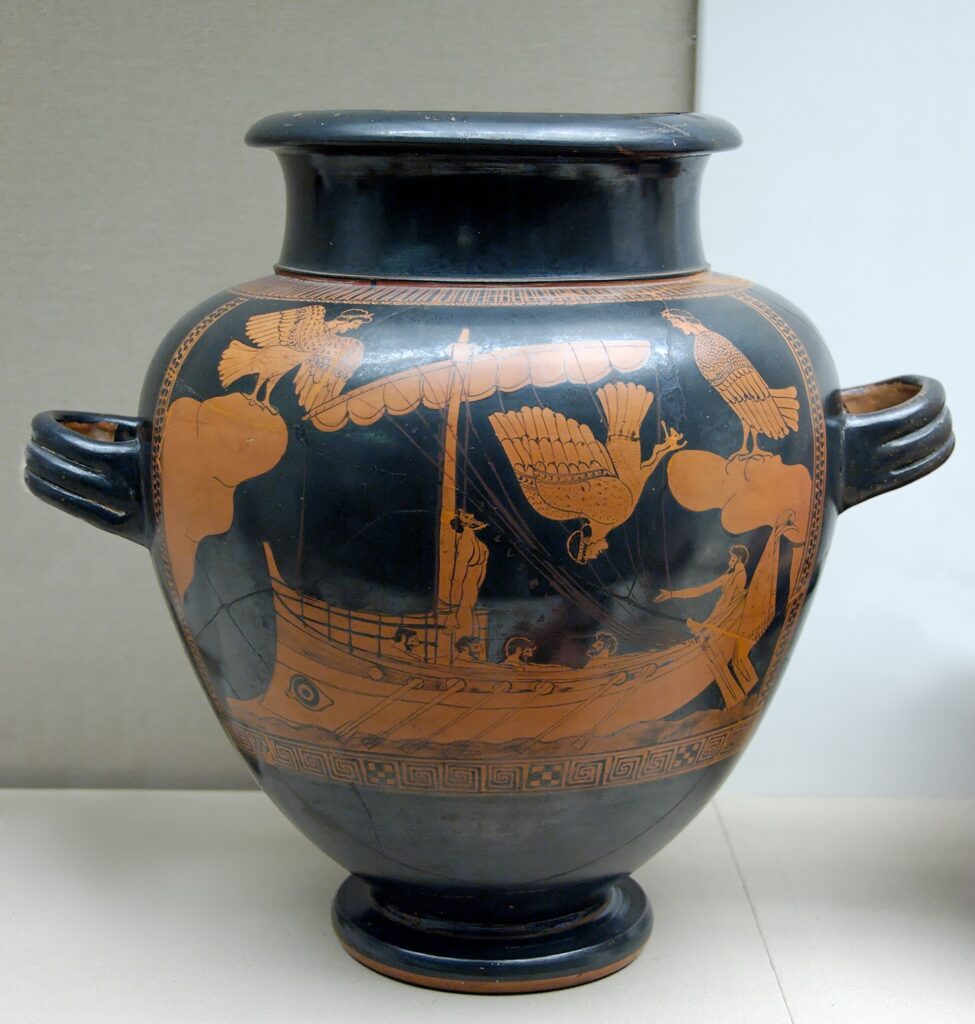
Odysseus, bound to the mast, listens to the Sirens (Odyssey 12.142–200). Attic red-figure stamnos attributed to the Siren Painter, c. 480–470 BC, from Vulci. British Museum, London, GR 1843,1103.31 (Vase E440). Photo: Jastrow (2006), released into the public domain, via Wikimedia Commons: https://commons.wikimedia.org/wiki/File:Odysseus_Sirens_BM_E440.jpg
Ideas for the classroom
1. A Book 5–13 reading route. Following Professor Hawes’s suggestion, here are nine passages that carry Odysseus from the storm after Calypso’s island to his waking on Ithaca, each short enough for a single lesson or homework:
- 5.282–381: Poseidon’s storm; Ino’s veil
- 6.145–250: Odysseus meets Nausicaa
- 9.345–394: The wine and the name Noman
- 9.473–566: Odysseus taunts the Cyclops
- 10.210–273: Circe turns the men to swine
- 11.90–149: Teiresias prophesies
- 12.142–200: The Sirens
- 12.201–259: Scylla and Charybdis
- 13.185–286: Odysseus awakes on Ithaca
At one a week, that is nine weeks of reading. Each also works as reading set before a lesson, with guided questions of the kind suggested in the CA’s Classroom Classics piece on literacy.
2. One myth, several tellings. Take Circe. Read Homer’s version (Odyssey 10.210–273), then the brisk summaries in Apollodorus (Epitome 7) and Hyginus (Fabulae 125), then Ovid, who has one of Odysseus’ crew, Macareus, tell it (Metamorphoses 14.221–319). What does each keep, and what does it leave out? Where does Hermes’ remedy appear? What does a handbook do that a poem does not?
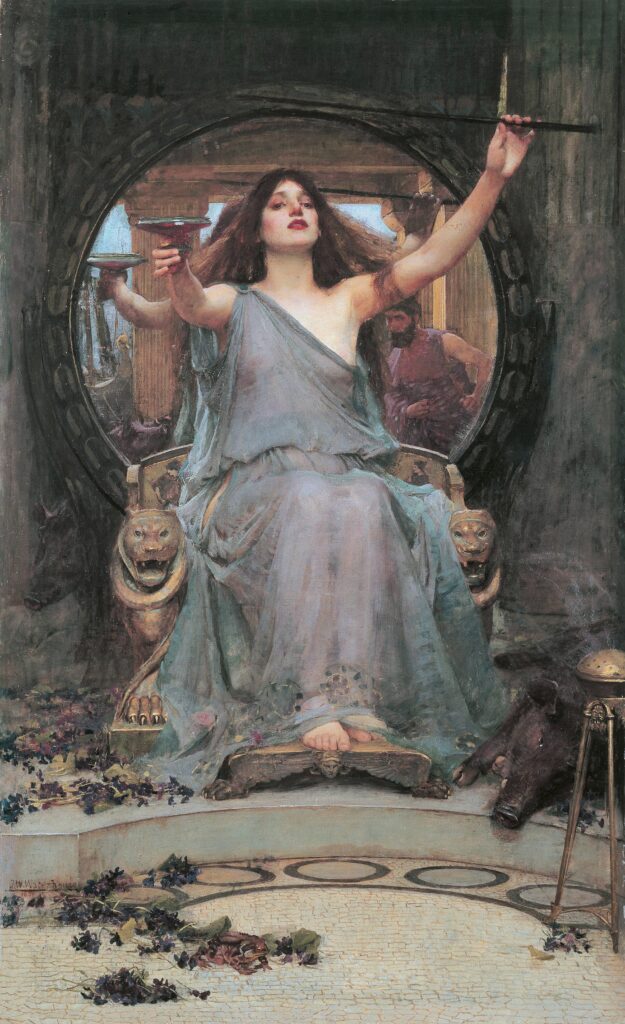
Circe holds out the cup to Odysseus, who is reflected in the mirror behind her (compare Odyssey 10.210–273). John William Waterhouse, Circe Offering the Cup to Ulysses, 1891, oil on canvas, Gallery Oldham. Public domain, via Wikimedia Commons: https://commons.wikimedia.org/wiki/File:Circe_Offering_the_Cup_to_Odysseus_(2457_x_4023px_ed.).jpg
3. Greek words in context. Start at 9.366, where Odysseus calls himself Οὖτις. Then move to 9.405–414: the other Cyclopes ask whether “no one” (μή τις) is harming Polyphemus, he answers “Οὖτίς με κτείνει”, and Odysseus laughs at how his name and his flawless cunning, μῆτις ἀμύμων, have tricked them. Students still learning the alphabet can hunt for the words; those further on can unpick the pun between μή τις and μῆτις.
4. One link, one passage. Instead of a photocopy, give a class a single passage link in a worksheet or on the board. Older students can use the “Cite this passage” button to practise referencing a primary source properly: author and line first, translation second.
Tell us what would help
We built this for readers like the CA’s, so we would be very glad to hear from teachers, lecturers and students. Which works or passages would you like to see? Do our divisions suit the way you teach? Have you spotted an error? Please write to info@greekmythology.com, or simply start reading at greekmythology.com/sources.
Alex Michalas is Founder & Director of NetProjects (Internet Projects Ltd), the UK company behind GreekMythology.com.